Just one in a series of posts of some State Laws that are on the Books in Mississippi. In Mississippi you can undo your Divorce!
In Mississippi, you can legally UNDIVORCE! Yes, you can have your judgment of divorce revoked by the Court that granted it. This is not a remarriage, but rather judicially undoing the legal divorce. Why, you ask?
Well, just like sometimes people marry the wrong person, sometimes you divorced the wrong person…
MCA 93-5-31, provides that a judgment of divorce may be revoked at any time by the Court that granted it. The Court may require “satisfactory proof of reconciliation,” as well as “such regulation as it may deem proper.” It requires a joint application of both parties. The process can be fairly simple and quick.
Upon approval by the Court, you can have your divorce erased and it’s as if you were never legally divorced. You get “credit” for being married those years you were not, so 25 years still equals 25 years.
This is a very unique quirk in MS law and not widely known. In fact, a few judges, I have heard, have questioned whether they had the authority to do an undivorce and if it was legal. They do and it is.
Matthew Thompson is a family law attorney in Mississippi and whether you marriage was a mistake or your divorce was a mistake, I can help!
Mississippi Law provides that you are entitled to your minor child’s records regardless of your Custody papers. This is regardless of the LEGAL CUSTODY and regardless of the PHYSICAL CUSTODY ORDER.
Miss. Code Ann., Sec. 93-5-26, guaranties non-custodial parent’s right to access to records and information pertaining to their minor child(ren).
“Notwithstanding any other provisions of law…access to records…pertaining to a minor child, including but not limited to medical, dental and school records, shall not be denied to a parent because the parent is not the child’s custodial parent if such parent’s rights have not been terminated by adoption or by termination of parental rights proceeding.”Id.
As a parent you have the right to this information by law. You can request medical records regarding your child’s health and appointments. You can get their school records, progress reports and grades. You are entitled to schedules, calendars and to know the events coming up.
Armed with this Statute and a smile, schools and doctor’s offices have no right to refuse you this information. But ask nicely. They are potential witnesses in the future!!
Matthew Thompson is a Child Custody Litigation & Child Welfare Attorney in Mississippi and wants parents to know their rights and fight for their right to…Parent!
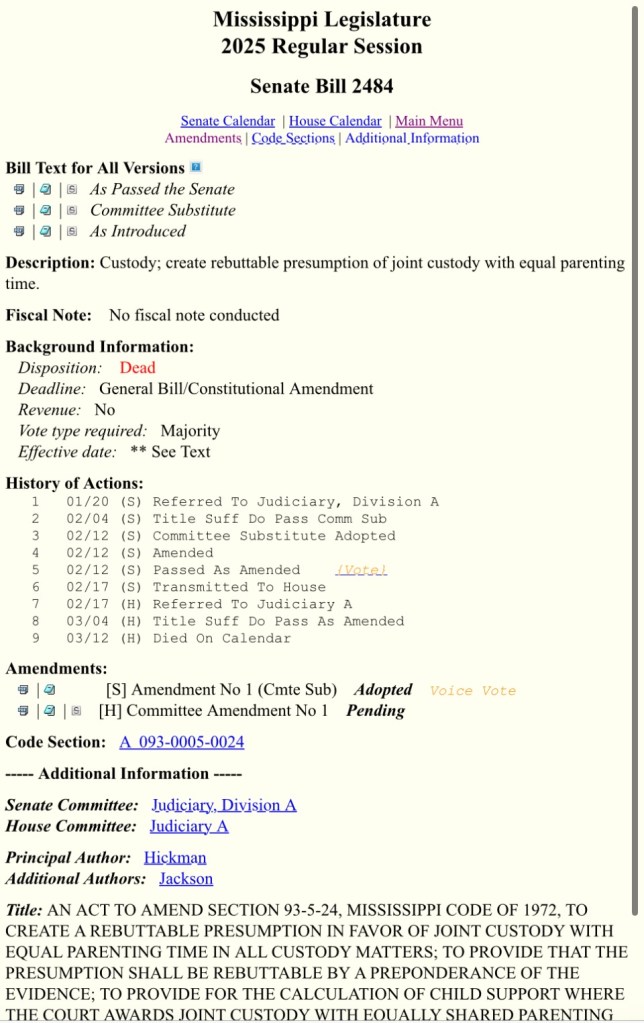
Senate Bill 2484, seeking to create a presumption of joint custody died yesterday, March 12.
This Bill which passed the Senate initially, then amended in the House, passed and sent back was ultimately not voted on and died a calendar death on 3/12/25.
It sought to require Joint Physical Custody and equal parenting time in every custody case unless the Court found a compelling reason to not grant shared parenting.
It necessarily would have put the every other weekend schedule as “standard” as outdated…
It also sought to amend child support determinations in the event joint custody was granted.
But, alas, it’s for naught. The scuttlebutt was there was an upswell of concerns about how far this proposal really went and that judges and even some family law attorneys had concerns.
Regardless, there will be no significant changes in family law this session…
Matthew Thompson is a child custody and child welfare attorney in Mississippi.
The sixth blog of a deep dive into the Foster Care World…this is the final post specifically regarding the Foster Parent Bill of Rights.
(q) The opportunity to develop confidence in making day-to-day decisions in regard to the child;
You are good enough…
(r) The opportunity to learn and grow in their vocation through planned education in caring for the child;
You will attend training seminars…
(s) The opportunity to be heard regarding agency practices that they may question;
This is interesting. The Judge may hear from you and they may not. Also, the chance to be heard regarding practices you may question does NOT mandate that you get answers or that anything happens as a result of you being heard.
(t) Information related to all costs eligible for reimbursement, including:
Some expenses are reimbursable.
(i) Reimbursement for costs of the child’s care in the form of a board payment based on the age of the child as prescribed in Section 43-15-17 unless the relative is exempt from foster care training and chooses to exercise the exemption; and
There are some hoops you have to jump through to get reimbursements.
(ii) Reimbursement for property damages caused by children in the custody of the Department of Child Protection Services in an amount not to exceed Five Hundred Dollars ($500.00), as evidenced by written documentation.
If the child damages your property you may be entitled to reimbursement.
The Department of Child Protection Services shall not incur liability for any damages as a result of providing this reimbursement.
Just because CPS is willing to reimburse up to $500.00 does not obligate them to that and certainly does not obligate the agency to anything more.
(12) The Department of Child Protection Services shall require the following responsibilities from participating persons who provide foster care and relative care:
Foster parents must do/adhere/abide by the following;
(a) Understanding the department’s function in regard to the foster care and relative care program and related social service programs;
Understand reunification is priority #1, placement/custody with a relative or fictive kin is #2, after that and depending on the circumstances a matter could include a TPR and adoption. This is a low percentage of the cases.
(b) Sharing with the department any information which may contribute to the care of children;
You have to share child welfare information. There are consequences for your license if you do not and it’s something that matters.
(c) Functioning within the established goals and objectives to improve the general welfare of the child;
This means cooperate in the permanent plan and concurrent plan, cooperate in visitation, child-related appointments and ultimately cooperate with CPS in every aspect. Cooperate even when you disagree or do not want to.
(d) Recognizing the problems in home placement that will require professional advice and assistance and that such help should be utilized to its full potential;
Acknowledge issues and seek out and ask for help. Do NOT minimize or cover it up in the hopes of “keeping” the child.
(e) Recognizing that the family who cares for the child will be one of the primary resources for preparing a child for any future plans that are made, including return to birth parent(s), termination of parental rights or reinstitutionalization;
You have a significant role. You are a successful foster parent if the permanent plan works!
(f) Expressing their views of agency practices which relate to the child with the appropriate staff member;
Don’t complain to the worker about the permanent plan. You of course could express legitimate concerns but you may have very limited to no information about the biological parent. Also, some case can take months or years. That child can be removed from foster care at any time.
(g) Understanding that all information shared with the persons who provide foster care or relative care about the child and his/her birth parent(s) must be held in the strictest of confidence;
Everything in Youth Court is TOP SECRET, it seems. You may have consequences for sharing information with persons you are not supposed to, which is essentially anyone other than CPS and persons that have a Court required obligation to be interacting with the child.
(h) Cooperating with any plan to reunite the child with his birth family and work with the birth family to achieve this goal; and
Cooperate. Cooperate. Cooperate. Natural parents have a fundamental right under the US Constitution to raise their child as they see fit. This will be honored unless and except it causes harm to the child. This is true even if you could provide a “better life” for the child.
(i) Attending dispositional review hearings and termination of parental rights hearings conducted by a court of competent jurisdiction, or providing their recommendations to the guardian ad litem in writing.
(13) The department shall develop a grievance procedure for foster parents to raise any complaints or concerns regarding the provisions of Section 43-15-13(11) or (12).
(14) Nothing in this section shall be construed to create a private right of action or claim on the part of any individual, the department, or any child-placing agency.
Matthew Thompson and Chad King are child welfare attorneys in the State of Mississippi. They have represented natural parents, foster parents, grandparents, other relatives, fictive kin, children and the Agency (CPS) throughout their decades of practice. (NOT all at the same time).
Courts usually grant custody to one parent or the other and the non-custodial parent exercises his time at places and locations he sees fit…
However, sometimes the Court needs an unusual solution to an unusual problem.
Consider the Birds Nest custody arrangement.
In a birds nest, the children stay in the “nest” aka the marital home and mom and dad take turns coming and going from the home.
During mom’s time she has custody to the children and the home, to the exclusion of dad.
During dad’s time he has exclusive custody of the kids and home and mom is excluded.
This is a good solution when the child has a unique need and having that structure of home base is in their best interest.
It’s also a viable solution when use of the home is needed by a party for work as the “home office” or tools of the trade are kept on the property.
This is not an often used remedy as it requires potentially 3 temporary residences, but can be an effective tool in the tool belt of solutions in limited circumstances.
Matthew Thompson is a child custody attorney and recommends the birds nest in unique cases.
Getting divorced allows the Government into your life!
Getting divorced happens. It can be relatively easy or it can be one of the most difficult times of your life. However, the impact can also last a lot longer than the few months or the few years of the litigation.
The Court has the authority to make you pay child support. And in Mississippi, that can last until the child turns 21. The age is NOT 18 and it cannot be, even by agreement.
Additionally, the Court could make you pay for college, even beyond age 21.
The Court can make you pay for health insurance and non-covered medical expenses, like co-pays, prescriptions, dental, vision, and all out-of-pocket expenses.
The Court can make you pay for extracurricular activities; sports, dance, cheer and scouts. The Court can make you pay for daycare, after care, summer care and school expenses.
Cars, cell phones and private school expenses are usually not Ordered but under certain circumstances the Court could.
The Court can obligate you to hundreds and even thousands of dollars $$ per month that are to be paid or you might even go to JAIL!!
Interestingly, we really don’t contemplate any of these potential obligations when we get married…
Matthew Thompson is a child custody and child support attorney in Mississippi.
Why I didn’t text you back: ○ I was asleep ○ I was driving ○ I was ghosting you ● I saw your text and told myself that I was going to respond, but I wanted to finish what I was doing first… After that, I got side-tracked and went to do something else and completely forgot your text even existed because I was doing ten thousand things at once until I went to text you days or even weeks later about something completely different.






 (601) 850-8000 - - BowTieLawyer.MS