Mississippi Law provides that you are entitled to your minor child’s records regardless of your Custody papers. This is regardless of the LEGAL CUSTODY and regardless of the PHYSICAL CUSTODY ORDER.
Miss. Code Ann., Sec. 93-5-26, guaranties non-custodial parent’s right to access to records and information pertaining to their minor child(ren).
“Notwithstanding any other provisions of law…access to records…pertaining to a minor child, including but not limited to medical, dental and school records, shall not be denied to a parent because the parent is not the child’s custodial parent if such parent’s rights have not been terminated by adoption or by termination of parental rights proceeding.”Id.
As a parent you have the right to this information by law. You can request medical records regarding your child’s health and appointments. You can get their school records, progress reports and grades. You are entitled to schedules, calendars and to know the events coming up.
Armed with this Statute and a smile, schools and doctor’s offices have no right to refuse you this information. But ask nicely. They are potential witnesses in the future!!
Matthew Thompson is a Child Custody Litigation & Child Welfare Attorney in Mississippi and wants parents to know their rights and fight for their right to…Parent!
Basic Adoption Statutory law is being amended by legislation. The change is replacing essentially one word with another.
MCA 93-17-3 requires a certificate by a doctor or nurse practitioner stating the adoptive child’s health and mental condition. This provision does not require the adoptive child be healthy, but is instead required so the adoptive parent knows IF there are any health concerns; mental or physical.
The statutory change is replacing “doctor” with “physician.”
The word “physician” in the section means a person licensed under Chapter 25, Title 73, Mississippi Code of 1972.
MCA 25-73-1 holds that “Every person who desires to practice medicine must first obtain a license to do so from the state board of medical licensure…”,
So the law change requires the child be evaluated by a licensed physician or nurse practitioner. This change eliminates “doctors” that are not licensed physicians from doing these certificates.
So Ph.D.s and J.D.s, like myself, are now excluded, by law.
I wonder what happened to prompt this change. It seems common sense as to what the statute meant and required…
Matthew Thompson and Chad King are Adoption and Child Welfare attorneys in the State of Mississippi and have never contemplated submitting a Doctor’s Certificate merely because they hold a Juris Doctorate (Doctor of Jurisprudence). And, don’t call us Doctor!
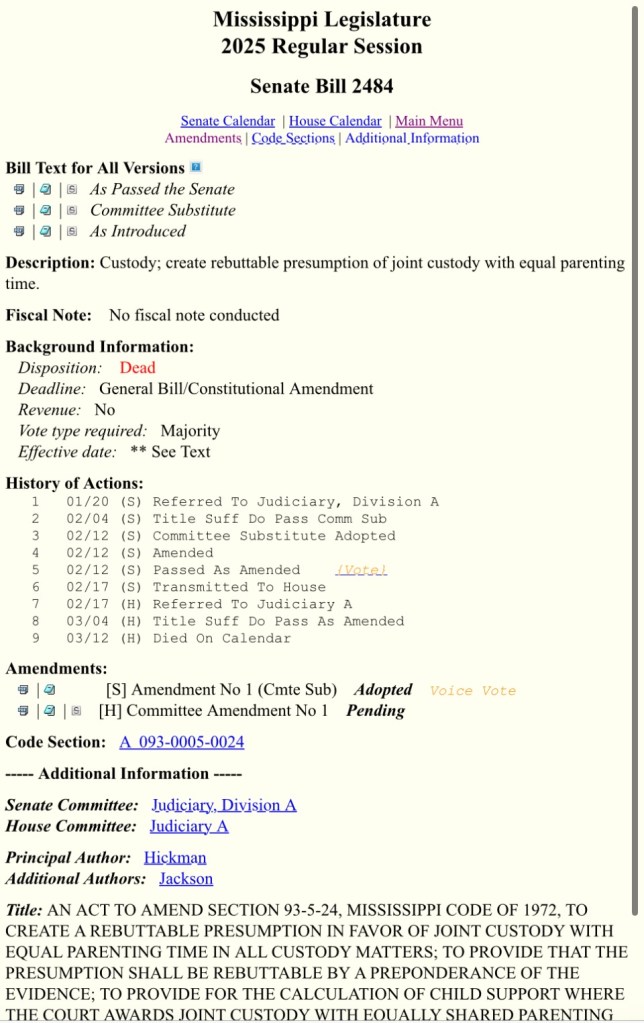
Senate Bill 2484, seeking to create a presumption of joint custody died yesterday, March 12.
This Bill which passed the Senate initially, then amended in the House, passed and sent back was ultimately not voted on and died a calendar death on 3/12/25.
It sought to require Joint Physical Custody and equal parenting time in every custody case unless the Court found a compelling reason to not grant shared parenting.
It necessarily would have put the every other weekend schedule as “standard” as outdated…
It also sought to amend child support determinations in the event joint custody was granted.
But, alas, it’s for naught. The scuttlebutt was there was an upswell of concerns about how far this proposal really went and that judges and even some family law attorneys had concerns.
Regardless, there will be no significant changes in family law this session…
Matthew Thompson is a child custody and child welfare attorney in Mississippi.
Eagle-candidate James, with Troop 15-Madison, needs your HELP!!
James is seeking donations of new and gently used children’s books. These books will be sorted by age-appropriateness and genre and given to Children within Child Protection Services.
Books will be provided to Youth Courts in the tri-county area for their playrooms/libraries, to Foster Parents, to CPS Social Workers and to the Children!
Watch the attached Video for more information.
Books may be dropped off at the Canton, Madison, and/or Ridgeland libraries, local area business will soon have drop boxes, as will local schools and churches.
You may also drop children’s books at Thompson Law Firm, located at 2060 Main Street, Madison, MS 39110.
You may email any questions or concerns to JamesParmley7@gmail.com or contact any Scout or Leader with Troop 15 Madison, or contact Matthew Thompson at Matthew@ThompsonLaw.ms or text him at (601) 906-6545.
A still-alive MS Bill seeks to tweak the Youth Court timeline when a child has been adjudicated neglected and abused for a permanency hearing.
The current law requires that the youth court shall conduct a permanency hearing within one hundred twenty (120) days or every sixty (60) days for children under three (3) years of age after the earlier of:
(i) An adjudication that the child has been abused or neglected; or
(ii) The date of the child’s removal from the allegedly abusive or neglectful custodian/parent.
The proposed changes requires;
the youth court shall conduct a permanency hearing within * * * three (3) months * * * after the earlier of the following and every three (3) months thereafter:
(i) An adjudication that the child has been abused or neglected; or (ii) The date of the child’s removal from the allegedly abusive or neglectful custodian/parent.
This change is not that significant and likely will not effect you.
Matthew Thompson is a child welfare attorney and noticed this when review pending legislation and needed a filler blog for the week of Spring Break.
Courts usually grant custody to one parent or the other and the non-custodial parent exercises his time at places and locations he sees fit…
However, sometimes the Court needs an unusual solution to an unusual problem.
Consider the Birds Nest custody arrangement.
In a birds nest, the children stay in the “nest” aka the marital home and mom and dad take turns coming and going from the home.
During mom’s time she has custody to the children and the home, to the exclusion of dad.
During dad’s time he has exclusive custody of the kids and home and mom is excluded.
This is a good solution when the child has a unique need and having that structure of home base is in their best interest.
It’s also a viable solution when use of the home is needed by a party for work as the “home office” or tools of the trade are kept on the property.
This is not an often used remedy as it requires potentially 3 temporary residences, but can be an effective tool in the tool belt of solutions in limited circumstances.
Matthew Thompson is a child custody attorney and recommends the birds nest in unique cases.
(p) Support from the family protection worker or the family protection specialist in efforts to do a better day-to-day job in caring for the child and in working to achieve the agency’s objectives for the child and the birth family through provision of:
Read this as help, info and cooperation from the social worker/investigator.
(i) A copy of the “Foster Child Information Form” and all other pertinent information about the child and the birth family, including medical, dental, behavioral health history, psychological information, educational status, cultural and family background, and other issues relevant to the child which are known to the department at the time the child is placed in foster care prior to the child’s placement with a foster parent or parents. The department shall make reasonable efforts to gather and provide all additional current medical, dental, behavioral, educational and psychological information reasonably available from the child’s service providers within fifteen (15) days of placement. When the department learns of such information after fifteen (15) days of placement, the department shall communicate such information to the foster parent as soon as practicable;
This is the Right to be informed about your foster child; the good, the bad and the important.
(ii) An explanation of the plan for placement of the child in the foster parent’s home and the ongoing and timely communication of any necessary information which is relevant to the care of the child, including any changes in the case plan;
This includes the right to know what the permanent plan and concurrent plan for custody/placement are. You have the right to timely updates about any changes in this plan. Interestingly, one placement ends the foster parent does not have the right to know where the child is.
(iii) Help in using appropriate resources to meet the child’s needs, including counseling or other services for victims of commercial sexual exploitation or human trafficking;
Counseling services will be made available if deemed necessary. While you will be privy to confidential information regarding this, you must maintain that confidentiality.
(iv) Direct interviews between the family protection worker or specialist and the child, previously discussed and understood by the foster parents;
You can learn about the info exchanged in in-person interviews between the child and the agency.
(v) Information regarding whether the child experienced commercial sexual exploitation or human trafficking;
You will be provided information if applicable, but also asked to hold this in strict confidence.
(vi) Information related to the Healthy, Hunger-Free Kids Act of 2010. Foster parents shall protect the confidentiality of the child by working directly with a designated school official to complete the application for free lunches.
The Healthy, Hunger-Free Kids Act of 2010 authorized funding for federal school meal and child nutrition programs and increased access to healthy food for low-income children. The bill that reauthorized these programs is often referred to by shorthand as the child nutrition reauthorization bill.
Matthew Thompson and Chad King are child welfare attorneys in the State of Mississippi. They have represented natural parents, foster parents, grandparents, other relatives, fictive kin, children and the Agency (CPS) throughout their decades of practice. (NOT all at the same time).





 (601) 850-8000 - - BowTieLawyer.MS