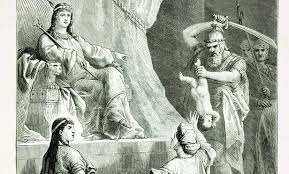
The WISDOM of Solomon; NOT splitting the baby.

“Splitting the Baby” is a phrase that is tossed around everyday.  Its use refers to making decisions that leave both parties unhappy.

download.jpgI have even heard a Judge say that if both parties leave unhappy then they must have gotten the result right. There may be some instances where this holds true, however there was no splitting of the baby in the Biblical account of Solomon’s decision. King Solomon’s decision was between two competing mothers embroiled in a custody dispute over a child, each claiming the child to be their own. 1 Kings 3:16 KJV

In the Biblical Custody Battle, King Solomon was faced with one infant and two mothers.  Solomon did not know which woman was the child’s real mother, so he arranged a test to see if he could determine the true mother.  In Solomon’s case, the real mother was willing to let the other woman have her child in order to spare the child’s life, while the other woman (whose own baby previously died) agreed with King Solomon that the baby should be cut in half, with each woman receiving a portion.  The real mother in King Solomon’s court was willing to make the ultimate sacrifice of giving the child up, so that the child would survive.   The Holy Bible, King James Version, 1 Kings 3:16.

Splitting the baby may be a solution if it’s not an actual baby. However, the true wisdom of Solomon was that he did NOT split the baby.

Matthew Thompson is a Child Custody attorney in Mississippi and has quoted the Bible as authority in legal arguments.

img_6390


Child Testimony and You

Whether to use child testimony is a difficult issue to resolve between parents and attorneys involved in child custody cases. Children know more than you think and also may have an opinion. However, child testimony is discouraged in most instances…

“We reiterate that parents in a divorce proceedingimgres.jpg should if at all possible refrain from calling any of the children of their marriage, of tender years at least, as witnesses, and counsel should advise their clients against doing so except in the most exigent cases.”- Jethrow v. Jethrow


So, do the children testify or not? For Family Law cases the leading authority is Jethrow vs. Jethrow, 571 So.2d 270 (Miss. 1990). This case lays the groundwork that the Court should use when assessing child testimony. Different Courts and different Judges apply Jethrow in varying ways, but the basic premise is, as follows;

  • A child witnesses of tender years, 12 and under for testimony purposes, testifying is subject to the discretion of the Judge. 
  • Before allowing such testimony the Judge “should satisfy himself that the child has the ability to perceive and remember events, to understand and answer questions intelligently, and to comprehend and accept the importance of truthfulness.”

Before excluding the testimony of a child witness of tender years in a divorce proceeding, the chancellor at a minimum should follow the procedure required by Crownover v. Crownover, 33 Ill.App.3rd 327, 337 N.E.2d 56 (1975):

  • The first hurdle is whether the child is competent to testify.
  • The Judge should confer in camera (meaning in the Judge’s chambers/office) with the child and determine whether or not the child’s testimony should be heard
  • The Judge has considerable discretion in conducting proceedings of this type, meaning it’s the judge’s decision.
  • The court should not, however, reject outright proposed testimony of a child in custody proceedings, where the omission of such crucial testimony might be harmful to the child’s best interests.
  • The trial court should take great pains to have an in camera conference with the child to determine the competency of the child,
  • as well as the competency of any evidence which the child might present.
  • The court should also then determine whether the best interests of the child would be served by permitting her to testify, or
  • Whether the child should be sheltered from testifying and being subjected to a vigorous cross-examination.
  • The Judge should report the essential material matters developed at the in camera conference on the record.
  • The Court should state the reasons for allowing or disallowing the testimony of the child, and
  • The Court should note the factual information which the court developed from the conference with the child which would be considered by the court in its ultimate determinations in the case.

A child testifying should be avoided if at all possible.

img_6390

Telling someone to Calm Down doesn’t help them Calm Down. 

Advice for the Day:

When you tell someone to calm down they usually do not and it could escalate the situation. 


Matthew Thompson~ http://www.BowTieLawyer.com (601) 850-8000

Best Selling Halloween Costume of 2017


Matthew Thompson, for the people.

The Expert Standard and Daubert. 

First things first. It’s pronounced “Dow-Burt.”It’s been pronounced “dough-bear” and “daw-Burt,” but the plaintiff’s attorney has set the record straight. 

Daubert and its progeny stand for several essentials on expert testimony. 

First, the Judge is gatekeeper: Under Rule 702, the task of “gatekeeping”, or assuring that scientific expert testimony truly proceeds from “scientific knowledge”, rests on the trial judge.

Relevance and reliability: This requires the trial judge to ensure that the expert’s testimony is “relevant to the task at hand” and that it rests “on a reliable foundation.” The Judge must find it more likely than not that the expert’s methods are reliable and reliably applied to the facts at hand.

Scientific knowledge = scientific method/methodology: A conclusion will qualify as scientific knowledge if the expert can demonstrate that it is the product of sound “scientific methodology” derived from the scientific method.

The Court defined “scientific methodology” as the process of formulating hypotheses and then conducting experiments to prove or disprove the hypothesis, and provided a set of factors in determining whether these criteria are met:

RULE 702. TESTIMONY BY EXPERT WITNESS
A witness who is qualified as an expert by knowledge, skill, experience, training, or education may testify in the form of an opinion or otherwise if:

(a) The expert’s scientific, technical, or other specialized knowledge will help the trier of fact to understand the evidence or to determine a fact in issue;

(b) The testimony is based on sufficient facts or data;

(c) The testimony is the product of reliable principles and methods; and

(d) The expert has reliably applied the principles and methods to the facts of the case.

Expertise in Court cases are subject to the tenets of Daubert and the Rules of Evidence concerning expert witness testimony. ~ Wikipedia. 

Matthew Thompson is a Mississippi divorce and child custody attorney and advises that experts can be a valuable tool in the litigation toolbox. 


There’s an old story about…

download.png

…a lawyer that would raise the “Jolly Roger” outside of his office on days he was in trial. The Jolly Roger was flown to identify a pirate ship about to attack. These were used during the early 18th century (the later part of the “Golden Age of Piracy“).

The flag most commonly identified as the Jolly Roger today, the skull and crossbones symbol on a black flag, was used during the 1710s by a number of pirate captains including Black Sam BellamyEdward England, and John Taylor, and it went on to become the most commonly used pirate flag during the 1720s.

The more you know.

Matthew Thompson is a Family Law attorney and warns you to watch out for the folks flying pirate flags.

img_6390


Witnesses, Facts and What you are Told.

You’re entitled to your own opinion, but you are not entitled to your own facts.

download.jpg

Testifying as a witness can be intimidating and scary. However, you do not have to let it get to you. Your job as a witness is to tell the truth, the whole truth and nothing but the truth. If you are testifying as a witness it is usually because you know something about the case and can help provide factual information. Your job as a witness, however is not to guess, speculate or even give your opinion, usually.

To be a good witness answer the question asked. Answer it with a “yes” or “no” or “I don’t know.” You may explain if you need to. Be direct. It is usually wise to only answer what is asked and it is also wise not to assume “facts” if you do NOT have personal knowledge of the underlying situation.

Also, someone telling you something does not make it a fact within your personal knowledge, even if they seem like they are telling the truth.

Matthew Thompson is a Family Law Attorney in Mississippi and reminds you to stick to the facts, just the facts.

img_6390

You MUST Prove Your Case.

Just because someone files something in Court does not make it so.

download.png

Allegations must be proven, by a preponderance of the evidence, meaning more likely than not, or by clear and convincing evidence, which is a much higher burden.

Filing papers is the easy part. Making wild accusations takes little effort. Backing up your claims with corroborating testimony, physical evidence or other support is the hard part.

Before you make a claim think about how you will prove it. Are there witnesses, recordings, photographs, videos, incident reports, police reports, documents or other evidence? If not, perhaps you need to rethink your claim. You may lose credibility with the Court.

Matthew Thompson is a Family Law attorney and warns you that crying wolf may lead to you getting the result you deserve.

 img_6390

Divorce, Child Custody & Support, Alimony, Contempt, Modification, Adoption, Appeals, Corporate Counsel, Professional Licensure Issues, and Civil Litigation.