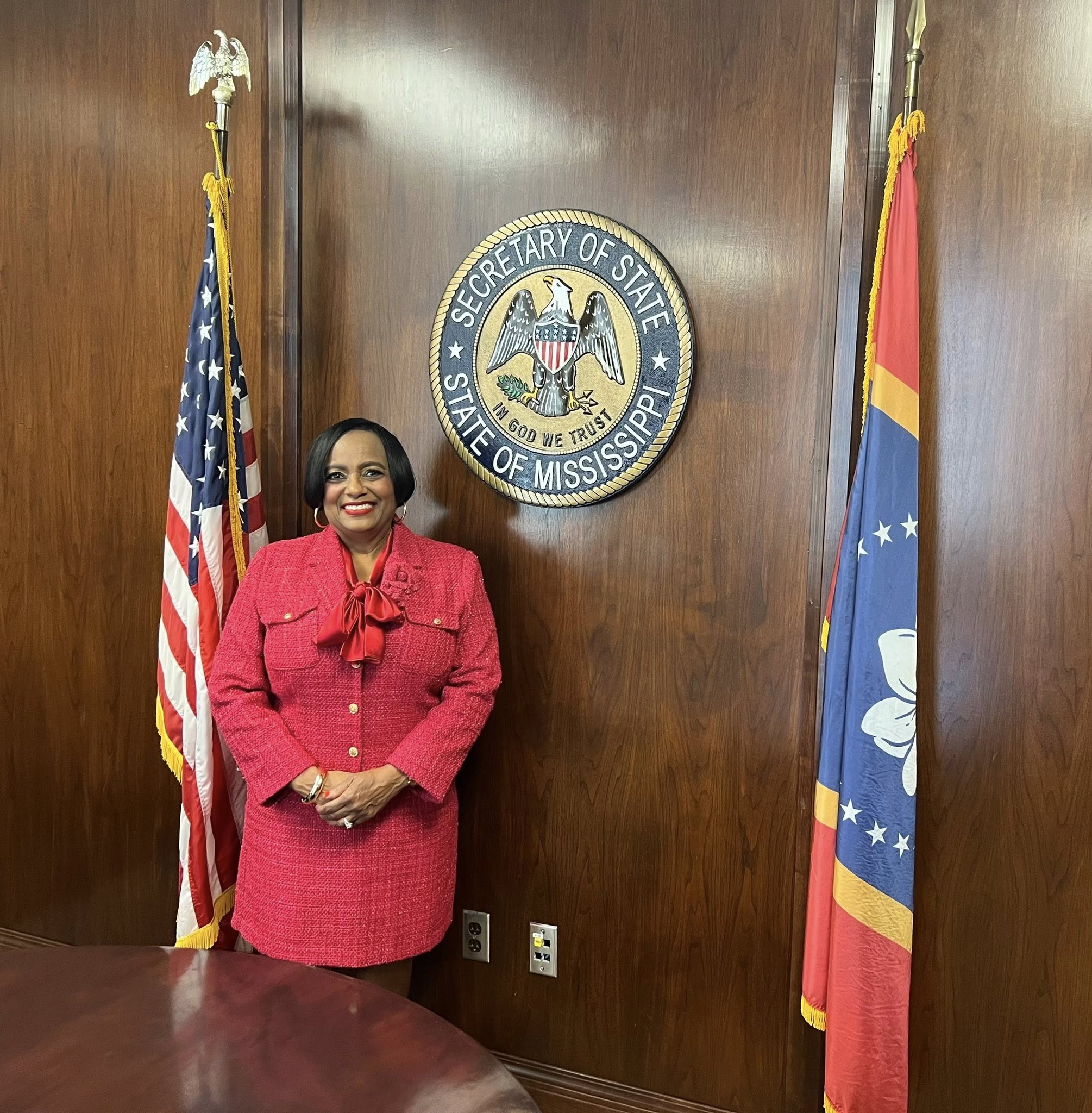
Hinds County Attorney, Bridgett Clayton, has qualified to run for Hinds County Chancery Judge!
“After much prayer and consideration, I am honored and excited to announce that I qualified for Hinds County Chancery Court Judge, District 5-3, on today.”
“I am ready to serve the citizens of Hinds County with God serving as a Lamp unto my feet and the Light unto my path as I seek election for this judicial seat to do justly, love mercy, and walk humbly before my God. Micah 6:8”
I am requesting your prayers and support during the campaign as well as on Election Day which is November 3.
Please be on the lookout for future campaign information. Thank You!
Matthew Thompson is a Chancery practitioner and knows-well the power, authority and responsibility that Chancellor’s have and the knowledge and wisdom they should possess. Attorney Bridgett Clayton has all of those qualities and then-some!
Please support Bridgett Clayton for Hinds County Chancellor!
It’s that time of year again. Proposed law/legislation is being kicked around by the State Legislature.
House Bill No. 11, proposed by Representative Arnold, seeks “TO PROHIBIT THE APPLICATION OF SHARIA LAW IN DIVORCE AND CHILD CUSTODY CASES; TO AMEND SECTION 11-63-1, MISSISSIPPI CODE OF 1972, TO CLARIFY THE PROHIBITION AGAINST USE OF SHARIA LAW IN COURT ORDERS.”
To date, this scribe is unaware of any Court’s using, applying or considering Sharia law in the State of Mississippi, as same would be contrary to the MS Constitution anyway.
Of interest, the Bill includes that a Mississippi Court “shall not enforce a foreign law that violates the Mississippi Constitution, any laws of this state, the United States Constitution, any laws or ratified treaties of the United States and the territories of the United States * * *.”
The Bill likewise bars enforcement of ” (b) Any order by a court, arbitrator, administrative agency or other adjudicative, mediation or enforcement authority that seeks to enforce foreign law in violation of paragraph (a) of this subsection (2) shall be void.”
So far, it’s basically saying MS Court’s will not honor foreign laws or Orders that violate MS law or Constitutional law or are based on factors contrary to MS law/US Constitutional considerations. Makes sense.
However, the Bill includes one other tidbit that could prove to have unintended consequences, “In Sections 11-7-301 through 11-7-309 “foreign judgment” means any judgment, decree or order of a court of the United States * * *. The term “foreign judgment” shall not mean or include any judgment, decree or order from any jurisdiction outside of the United States or its territories, or any judgment from another state or territory of the United States that applies law from a jurisdiction outside of the United States or its territories.
This last paragraph seems to invalidate any “foreign judgment” that was not secured within the U.S.
Why do you care? Is that foreign Adoption, which is a Judgment, valid?
That “foreign” quickie Divorce in Haiti or the Dominican Republic? Are they valid?
Up and until this Bill, Mississippi and the United States have routinely recognized foreign judgments IF they were obtained in a procedural and substantive manner consistent with that foreign entities jurisdiction and law. This is called Comity and it’s a necessary legal concept.
Does HB. No. 11 unintentionally seek to overturn Comity? I argue that it certainly may and that’s no laughing matter!
Matthew Thompson is a Family law attorney and has handled multiple matters that involve foreign decrees and clients from all over the world.
Basic Adoption Statutory law is being amended by legislation. The change is replacing essentially one word with another.
MCA 93-17-3 requires a certificate by a doctor or nurse practitioner stating the adoptive child’s health and mental condition. This provision does not require the adoptive child be healthy, but is instead required so the adoptive parent knows IF there are any health concerns; mental or physical.
The statutory change is replacing “doctor” with “physician.”
The word “physician” in the section means a person licensed under Chapter 25, Title 73, Mississippi Code of 1972.
MCA 25-73-1 holds that “Every person who desires to practice medicine must first obtain a license to do so from the state board of medical licensure…”,
So the law change requires the child be evaluated by a licensed physician or nurse practitioner. This change eliminates “doctors” that are not licensed physicians from doing these certificates.
So Ph.D.s and J.D.s, like myself, are now excluded, by law.
I wonder what happened to prompt this change. It seems common sense as to what the statute meant and required…
Matthew Thompson and Chad King are Adoption and Child Welfare attorneys in the State of Mississippi and have never contemplated submitting a Doctor’s Certificate merely because they hold a Juris Doctorate (Doctor of Jurisprudence). And, don’t call us Doctor!
Adoption is a legal process whereby a person assumes the parenting of another, usually a child, from that person’s biological or legal parents. This permanently transfer all rights, obligations and responsibilities, along with filiation, from the biological parents to the adoptive parents.
Numerous Mississippi children are eligible for adoption right NOW. The Mississippi Dept. of Child Protection Services maintains a list of children legally free for adoption in its Heart Gallery.
Children of all ages, races, backgrounds and situations are eligible for adoption. Some of the children have special educational, emotional, or medical needs. While this information is confidential and does not appear in the children’s descriptions, it will be provided to qualified adoptive placements well prior to any adoption finalization. More detailed information about the child will be shared with interested families as they continue the matching process.
If you are interested in a child featured on the Mississippi Heart Gallery, you may request additional information and inquire about the availability of the child by clicking the child’s bio and completing the inquiry form, emailing the Adoptions Team, or calling the Heart Gallery hotline at (601) 359-4133.
This inquiry will be forwarded to the child’s worker for review and consideration based on the unique needs of the child.
A child eligible from the Heart Gallery could be adopted as soon as a proper match and good fit is established.
Matthew Thompson and Chad King are child welfare and adoption attorneys in the State of Mississippi. They have been a part of hundreds of adoptions in Mississippi throughout the State.
(f) The opportunity to communicate and collaborate, without threat of reprisal, with a department representative when further educational services are needed to ensure the child’s educational needs are met, including services such as an Individualized Educational Plan (IEP), tutoring, occupational therapy, speech therapy and after-school programs;
A foster parent has the right and the obligation to be involved in the education of the foster child. This is the nuts and bolts of educating a young person. From getting them to and from school, events and meetings to addressing tardies, absences, tests, quizzes and programs.
(g) The opportunity to attend all IEP meetings, along with the department worker, at the child’s school as long as the child is in custody and receiving special educational services;
The foster parent should be attending and has the right to attend Individualized Educational Plan (IEP) meetings and helping be a part of the progress and solution. This also means cooperating with the educational goals set by the Agency, school and teachers and NOT supplanting your own independent judgment for that of the School. Issues should be shared with the teacher and agency (social worker) and moved up the food chain if not addressed appropriately.
(h) The opportunity to communicate with the foster child’s guardian ad litem;
The GAL is the investigative arm of the Court and quasi-attorney for the child. They are tasked with interviewing the child, the parents, relatives, and others regarding the reason CPS is involved in the first place. It is NOT unusual for the GAL to not interview foster parents. All of the facts and circumstances giving rise to CPS involvement are not due to anything the foster parent did or did not do. Also, as the plan is almost always reunification in the first instance, the GAL is not too worried with how the licensed, state-approved foster home is doing…however, as a Foster Parent you have the opportunity to communicate and should if its involving the best interests of the child.
(i) The opportunity to attend all youth court hearings involving a foster child occurring while that child is placed in their care without being a party to the youth court action, unless the youth court determines that any foster parent should not be present. Foster parents may attend all youth court hearings and have legal counsel attend and observe with them if the child’s permanent plan is adoption by the foster parents, unless the youth court determines that any foster parent should not be present. Foster parents may communicate with the guardian ad litem in writing at any time. Foster parents may ask to be heard concerning the best interest of the child at any disposition or permanency hearing;
This one is tricky. It states you have the right to attend hearings and then creates caveats. First, the Court (the Judge) has to determine you may or may not attend. This is discretionary. Some judges allow the foster parent to attend and some do not. If are allowed to attend you may have counsel attend with you and OBSERVE. Did you get that? Observe. The FPBOR does not say you may participate and a foster parent is NOT a party.
This mean its possible for you to attend, but you may well not get to ask any questions or really be involved in the hearing. Alternatively, the judge may allow for participation if deemed necessary and in the child’s best interests.
If the permanent plan is adoption the Court is more inclined to allow attendance. Also, if its a disposition hearing or permanency hearing/review a foster parent may ask to be heard. This means you have the opportunity to address the Court. It also means you may be subject to questioning by the Judge, Prosecutor, GAL, parent(s)(or their attorney) and CPS-agency attorneys.
(j) When the dates of the permanency hearing and permanency review hearing have been set by the youth court, and if necessary to fulfill the notice requirements, the judge or the judge’s designee shall order the clerk of the youth court to issue a summons to the foster parents to appear personally at the hearings as provided by Section 43-21-501;
A summons is a Court-issued document for your required attendance to a hearing for a time and date certain. If summoned there could be consequences if you do not attend.
(k) The opportunity to request from the youth court permission to communicate with the child’s birth family, previous foster parents of the child, and prospective and finalized adoptive parents of the child, without the threat of reprisal. However, this right creates no obligation of the birth family, previous foster parents, or prospective and finalized adoptive parents to communicate in return;
This allows a foster parent the chance to get information, updates and the like or possibly even provide information. However, no response is required to any inquiry and there is no obligation on any of the above-named positions to do anything at all in response to the communications. This can be quite frustrating as you are merely trying to get an update or provide some helpful information for consideration.
Matthew Thompson and Chad King are child welfare attorneys in the State of Mississippi. They have represented natural parents, foster parents, grandparents, other relatives, fictive kin, children and the Agency (CPS) throughout their decades of practice. (NOT all at the same time).
In 2023, the Mississippi Legislature enacted changes in child welfare, enacting a Foster Parents’ Bill of Rights. But, what does this mean…? Stay tuned for a multi-part blog diving into the FPBOR and what it means AND what it doesn’t mean…
Foster Parents’ Bill of Rights and Responsibilities
The Department of Child Protection Services shall extend the following rights to persons who provide foster care and relative care:
(a) A clear understanding of their role while providing care and the roles of the birth parent(s) and the placement agency in respect to the child in care;
(b) Respect, consideration, trust and value as a family who is making an important contribution to the agency’s objectives;
(c) Notification of benchmarks that will be required of the foster parent such as appointments, home visits with department personnel, visitations of the child at school and meetings between department personnel and the child’s family;
(d) Advance notice of information regarding scheduled meetings other than meetings where the Department of Child Protection Services personnel or social workers are going to the foster parent’s home for site visits, appointments and court hearings concerning the foster child;
(e) The opportunity to communicate with professionals who work with the foster child including therapists, physicians and teachers who work directly with the child;
(f) The opportunity to communicate and collaborate, without threat of reprisal, with a department representative when further educational services are needed to ensure the child’s educational needs are met, including services such as an Individualized Educational Plan (IEP), tutoring, occupational therapy, speech therapy and after-school programs;
(g) The opportunity to attend all IEP meetings, along with the department worker, at the child’s school as long as the child is in custody and receiving special educational services;
(h) The opportunity to communicate with the foster child’s guardian ad litem;
(i) The opportunity to attend all youth court hearings involving a foster child occurring while that child is placed in their care without being a party to the youth court action, unless the youth court determines that any foster parent should not be present. Foster parents may attend all youth court hearings and have legal counsel attend and observe with them if the child’s permanent plan is adoption by the foster parents, unless the youth court determines that any foster parent should not be present. Foster parents may communicate with the guardian ad litem in writing at any time. Foster parents may ask to be heard concerning the best interest of the child at any disposition or permanency hearing;
(j) When the dates of the permanency hearing and permanency review hearing have been set by the youth court, and if necessary to fulfill the notice requirements, the judge or the judge’s designee shall order the clerk of the youth court to issue a summons to the foster parents to appear personally at the hearings as provided by Section 43-21-501;
(k) The opportunity to request from the youth court permission to communicate with the child’s birth family, previous foster parents of the child, and prospective and finalized adoptive parents of the child, without the threat of reprisal. However, this right creates no obligation of the birth family, previous foster parents, or prospective and finalized adoptive parents to communicate in return;
(l) Involvement in all the agency’s crucial decisions regarding the child as team members who have pertinent information based on their day-to-day knowledge of the child in care and involvement in planning, including, but not limited to, individual service planning meetings, foster care review, individual educational planning meetings, and medical appointments;
(m) The opportunity to participate in the planning of visitations between the child and the child’s siblings, parents or former guardians or other biological family members which have been previously authorized by the youth court. Visitations shall be scheduled at a time and place meeting the needs of the child, the biological family, and the foster family.
Recognizing that visitation with family members is an important right of children in foster care, foster parents shall be flexible and cooperative with regard to family visits but shall retain the right to reasonable advance notice of all scheduled visitations;
(n) The ability to communicate with department personnel or representatives twenty-four (24) hours a day, seven (7) days a week, for the purpose of aiding the foster parent;
(o) A comprehensive list of all resources available to the foster parent and child, including dental providers, medical providers, respite workers in the area, day cares, and methods for submitting reimbursements;
(p) Support from the family protection worker or the family protection specialist in efforts to do a better day-to-day job in caring for the child and in working to achieve the agency’s objectives for the child and the birth family through provision of:
(i) A copy of the “Foster Child Information Form” and all other pertinent information about the child and the birth family, including medical, dental, behavioral health history, psychological information, educational status, cultural and family background, and other issues relevant to the child which are known to the department at the time the child is placed in foster care prior to the child’s placement with a foster parent or parents. The department shall make reasonable efforts to gather and provide all additional current medical, dental, behavioral, educational and psychological information reasonably available from the child’s service providers within fifteen (15) days of placement. When the department learns of such information after fifteen (15) days of placement, the department shall communicate such information to the foster parent as soon as practicable;
(ii) An explanation of the plan for placement of the child in the foster parent’s home and the ongoing and timely communication of any necessary information which is relevant to the care of the child, including any changes in the case plan;
(iii) Help in using appropriate resources to meet the child’s needs, including counseling or other services for victims of commercial sexual exploitation or human trafficking;
(iv) Direct interviews between the family protection worker or specialist and the child, previously discussed and understood by the foster parents;
(v) Information regarding whether the child experienced commercial sexual exploitation or human trafficking;
(vi) Information related to the Healthy, Hunger-Free Kids Act of 2010. Foster parents shall protect the confidentiality of the child by working directly with a designated school official to complete the application for free lunches.
(q) The opportunity to develop confidence in making day-to-day decisions in regard to the child;
(r) The opportunity to learn and grow in their vocation through planned education in caring for the child;
(s) The opportunity to be heard regarding agency practices that they may question;
(t) Information related to all costs eligible for reimbursement, including:
(i) Reimbursement for costs of the child’s care in the form of a board payment based on the age of the child as prescribed in Section 43-15-17 unless the relative is exempt from foster care training and chooses to exercise the exemption; and
(ii) Reimbursement for property damages caused by children in the custody of the Department of Child Protection Services in an amount not to exceed Five Hundred Dollars ($500.00), as evidenced by written documentation.
The Department of Child Protection Services shall not incur liability for any damages as a result of providing this reimbursement.
(12) The Department of Child Protection Services shall require the following responsibilities from participating persons who provide foster care and relative care:
(a) Understanding the department’s function in regard to the foster care and relative care program and related social service programs;
(b) Sharing with the department any information which may contribute to the care of children;
(c) Functioning within the established goals and objectives to improve the general welfare of the child;
(d) Recognizing the problems in home placement that will require professional advice and assistance and that such help should be utilized to its full potential;
(e) Recognizing that the family who cares for the child will be one of the primary resources for preparing a child for any future plans that are made, including return to birth parent(s), termination of parental rights or reinstitutionalization;
(f) Expressing their views of agency practices which relate to the child with the appropriate staff member;
(g) Understanding that all information shared with the persons who provide foster care or relative care about the child and his/her birth parent(s) must be held in the strictest of confidence;
(h) Cooperating with any plan to reunite the child with his birth family and work with the birth family to achieve this goal; and
(i) Attending dispositional review hearings and termination of parental rights hearings conducted by a court of competent jurisdiction, or providing their recommendations to the guardian ad litem in writing.
(13) The department shall develop a grievance procedure for foster parents to raise any complaints or concerns regarding the provisions of Section 43-15-13(11) or (12).
(14) Nothing in this section shall be construed to create a private right of action or claim on the part of any individual, the department, or any child-placing agency.
Matthew Thompson is a child custody attorney in Mississippi and routinely presents at Guardian Ad Litem training and has presented at Foster Parent Training.











 (601) 850-8000 - - BowTieLawyer.MS