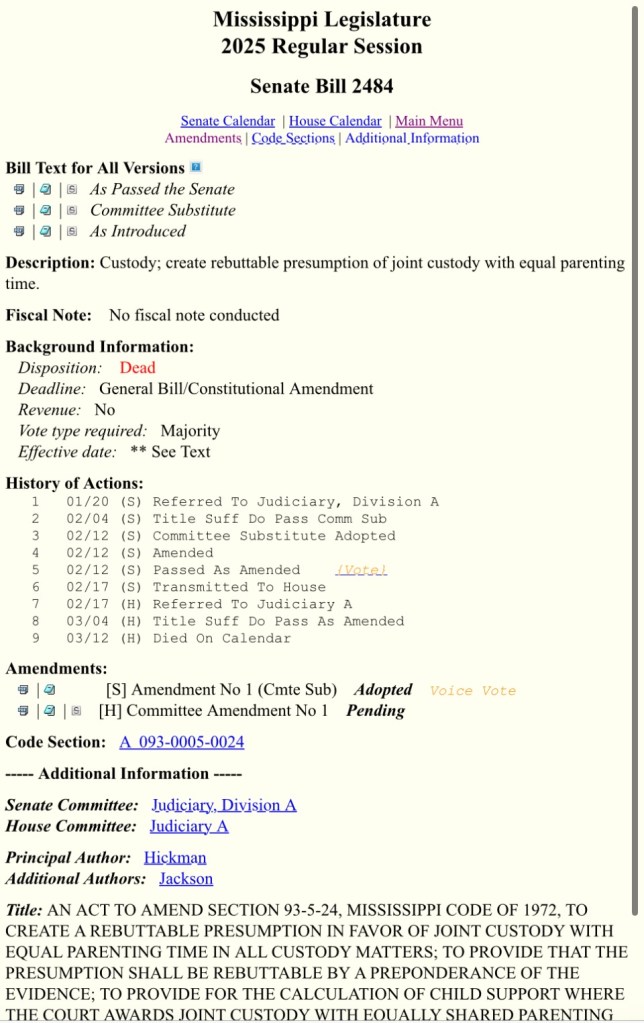
Senate Bill 2484, seeking to create a presumption of joint custody died yesterday, March 12.
This Bill which passed the Senate initially, then amended in the House, passed and sent back was ultimately not voted on and died a calendar death on 3/12/25.
It sought to require Joint Physical Custody and equal parenting time in every custody case unless the Court found a compelling reason to not grant shared parenting.
It necessarily would have put the every other weekend schedule as “standard” as outdated…
It also sought to amend child support determinations in the event joint custody was granted.
But, alas, it’s for naught. The scuttlebutt was there was an upswell of concerns about how far this proposal really went and that judges and even some family law attorneys had concerns.
Regardless, there will be no significant changes in family law this session…
Matthew Thompson is a child custody and child welfare attorney in Mississippi.
Eagle-candidate James, with Troop 15-Madison, needs your HELP!!
James is seeking donations of new and gently used children’s books. These books will be sorted by age-appropriateness and genre and given to Children within Child Protection Services.
Books will be provided to Youth Courts in the tri-county area for their playrooms/libraries, to Foster Parents, to CPS Social Workers and to the Children!
Watch the attached Video for more information.
Books may be dropped off at the Canton, Madison, and/or Ridgeland libraries, local area business will soon have drop boxes, as will local schools and churches.
You may also drop children’s books at Thompson Law Firm, located at 2060 Main Street, Madison, MS 39110.
You may email any questions or concerns to JamesParmley7@gmail.com or contact any Scout or Leader with Troop 15 Madison, or contact Matthew Thompson at Matthew@ThompsonLaw.ms or text him at (601) 906-6545.
A still-alive MS Bill seeks to tweak the Youth Court timeline when a child has been adjudicated neglected and abused for a permanency hearing.
The current law requires that the youth court shall conduct a permanency hearing within one hundred twenty (120) days or every sixty (60) days for children under three (3) years of age after the earlier of:
(i) An adjudication that the child has been abused or neglected; or
(ii) The date of the child’s removal from the allegedly abusive or neglectful custodian/parent.
The proposed changes requires;
the youth court shall conduct a permanency hearing within * * * three (3) months * * * after the earlier of the following and every three (3) months thereafter:
(i) An adjudication that the child has been abused or neglected; or (ii) The date of the child’s removal from the allegedly abusive or neglectful custodian/parent.
This change is not that significant and likely will not effect you.
Matthew Thompson is a child welfare attorney and noticed this when review pending legislation and needed a filler blog for the week of Spring Break.
A new bill in Mississippi will require Joint Physical Custody & EQUAL Parenting TIME, unless the Court finds a compelling reason not too…
Senate Bill 2484 requires that, “There shall be a rebuttable presumption that joint custody and equally shared parenting time is in the best interest of the child. If the court grants joint custody and equally shared parenting time, the court shall construct a parenting time schedule which maximizes the time each parent has with the child and ensures the best interest of the child is met.“
(ii) The presumption created in subparagraph (i) of this paragraph shall be rebuttable by a preponderance of the evidence. A court that does not award joint custody with equally shared parenting time shall document the reasons for deviating from the presumption.
(b) To calculate child support for joint custody with equally shared parenting time, unless the court determines a deviation from this paragraph is in the best interest of the child, the court shall:
(i) Calculate a child-support award under the guidelines of Section 43-19-101 for each parent as if each parent was the obligor;
(ii) Calculate the difference in the two (2) awards by subtracting the lesser award from the larger award; and
(iii) Order the difference in the two (2) awards to be paid by the parent who has the higher adjusted gross income to the parent with the lower adjusted gross income.
(c) Upon petition of both parents, the court may grant legal and/or physical custody to one (1) parent without documenting a reason for deviation.
This is a potential monumental change in child custody law, primarily the requirement for equal parenting time. If signed into law this does away with the every other weekend visitation schedule…
Additionally, it drastically changes the child support landscape and can have “mom” paying “dad” dependent upon the math.
This made its way through the legislature with little fanfare and virtually zero input from practitioners and judges.
Matthew Thompson is child custody attorney and believes children do best with both parents as involved as possible.
Courts usually grant custody to one parent or the other and the non-custodial parent exercises his time at places and locations he sees fit…
However, sometimes the Court needs an unusual solution to an unusual problem.
Consider the Birds Nest custody arrangement.
In a birds nest, the children stay in the “nest” aka the marital home and mom and dad take turns coming and going from the home.
During mom’s time she has custody to the children and the home, to the exclusion of dad.
During dad’s time he has exclusive custody of the kids and home and mom is excluded.
This is a good solution when the child has a unique need and having that structure of home base is in their best interest.
It’s also a viable solution when use of the home is needed by a party for work as the “home office” or tools of the trade are kept on the property.
This is not an often used remedy as it requires potentially 3 temporary residences, but can be an effective tool in the tool belt of solutions in limited circumstances.
Matthew Thompson is a child custody attorney and recommends the birds nest in unique cases.
Getting divorced allows the Government into your life!
Getting divorced happens. It can be relatively easy or it can be one of the most difficult times of your life. However, the impact can also last a lot longer than the few months or the few years of the litigation.
The Court has the authority to make you pay child support. And in Mississippi, that can last until the child turns 21. The age is NOT 18 and it cannot be, even by agreement.
Additionally, the Court could make you pay for college, even beyond age 21.
The Court can make you pay for health insurance and non-covered medical expenses, like co-pays, prescriptions, dental, vision, and all out-of-pocket expenses.
The Court can make you pay for extracurricular activities; sports, dance, cheer and scouts. The Court can make you pay for daycare, after care, summer care and school expenses.
Cars, cell phones and private school expenses are usually not Ordered but under certain circumstances the Court could.
The Court can obligate you to hundreds and even thousands of dollars $$ per month that are to be paid or you might even go to JAIL!!
Interestingly, we really don’t contemplate any of these potential obligations when we get married…
Matthew Thompson is a child custody and child support attorney in Mississippi.
(l) Involvement in all the agency’s crucial decisions regarding the child as team members who have pertinent information based on their day-to-day knowledge of the child in care and involvement in planning, including, but not limited to, individual service planning meetings, foster care review, individual educational planning meetings, and medical appointments;
The foster parent has the right to “be involved” in decisions as a “team member” that has pertinent information. This involvement includes that you may share your opinion…however, it does not go so far as to veto any decision made by the Court or CPS. The above is a paragraph loaded with buzz words, but provides little meat regarding actual decision making.
(m) The opportunity to participate in the planning of visitations between the child and the child’s siblings, parents or former guardians or other biological family members which have been previously authorized by the youth court. Visitations shall be scheduled at a time and place meeting the needs of the child, the biological family, and the foster family.
The foster parent has the right to “participate in planning” visitations. This is not the right to deny or refuse visitations. This is not the right to alter, amend or change the Court-ordered visitation. This is the right to let CPS or the Court know that Wednesday nights, 6:00 pm-9:00 pm isn’t a convenient time for a visit as you are obligated to cook chicken tenders at church. Otherwise, as a foster parent, you are obligated to cooperate with visitation, even if you disagree with the idea and even if the child does not want to go. The child does not “drive the boat.”
Recognizing that visitation with family members is an important right of children in foster care, foster parents shall be flexible and cooperative with regard to family visits but shall retain the right to reasonable advance notice of all scheduled visitations;
Last minute changes or unplanned visits may not work, however, as a foster parent you have agreed to try and make it happen. Please do. The fastest way to no longer be a foster parent is interfere with visits, aka the permanent plan of reunification.
(n) The ability to communicate with department personnel or representatives twenty-four (24) hours a day, seven (7) days a week, for the purpose of aiding the foster parent;
Again, this is really the ability to provide info or request a call back. You may not get a call back at midnight. Also, if you are providing information for the worker to know/consider, you may not get a text confirmation…
(o) A comprehensive list of all resources available to the foster parent and child, including dental providers, medical providers, respite workers in the area, day cares, and methods for submitting reimbursements;
This means you may be provided a list of providers if its determined that those services are necessary. IF they are not deemed necessary you may not get a list. If these services are deemed necessary it is the foster parent’s responsibility to see that arrangements are made for the child to use these services, with assistance of the agency.
Matthew Thompson and Chad King are child welfare attorneys in the State of Mississippi. They have represented natural parents, foster parents, grandparents, other relatives, fictive kin, children and the Agency (CPS) throughout their decades of practice. (NOT all at the same time).
(f) The opportunity to communicate and collaborate, without threat of reprisal, with a department representative when further educational services are needed to ensure the child’s educational needs are met, including services such as an Individualized Educational Plan (IEP), tutoring, occupational therapy, speech therapy and after-school programs;
A foster parent has the right and the obligation to be involved in the education of the foster child. This is the nuts and bolts of educating a young person. From getting them to and from school, events and meetings to addressing tardies, absences, tests, quizzes and programs.
(g) The opportunity to attend all IEP meetings, along with the department worker, at the child’s school as long as the child is in custody and receiving special educational services;
The foster parent should be attending and has the right to attend Individualized Educational Plan (IEP) meetings and helping be a part of the progress and solution. This also means cooperating with the educational goals set by the Agency, school and teachers and NOT supplanting your own independent judgment for that of the School. Issues should be shared with the teacher and agency (social worker) and moved up the food chain if not addressed appropriately.
(h) The opportunity to communicate with the foster child’s guardian ad litem;
The GAL is the investigative arm of the Court and quasi-attorney for the child. They are tasked with interviewing the child, the parents, relatives, and others regarding the reason CPS is involved in the first place. It is NOT unusual for the GAL to not interview foster parents. All of the facts and circumstances giving rise to CPS involvement are not due to anything the foster parent did or did not do. Also, as the plan is almost always reunification in the first instance, the GAL is not too worried with how the licensed, state-approved foster home is doing…however, as a Foster Parent you have the opportunity to communicate and should if its involving the best interests of the child.
(i) The opportunity to attend all youth court hearings involving a foster child occurring while that child is placed in their care without being a party to the youth court action, unless the youth court determines that any foster parent should not be present. Foster parents may attend all youth court hearings and have legal counsel attend and observe with them if the child’s permanent plan is adoption by the foster parents, unless the youth court determines that any foster parent should not be present. Foster parents may communicate with the guardian ad litem in writing at any time. Foster parents may ask to be heard concerning the best interest of the child at any disposition or permanency hearing;
This one is tricky. It states you have the right to attend hearings and then creates caveats. First, the Court (the Judge) has to determine you may or may not attend. This is discretionary. Some judges allow the foster parent to attend and some do not. If are allowed to attend you may have counsel attend with you and OBSERVE. Did you get that? Observe. The FPBOR does not say you may participate and a foster parent is NOT a party.
This mean its possible for you to attend, but you may well not get to ask any questions or really be involved in the hearing. Alternatively, the judge may allow for participation if deemed necessary and in the child’s best interests.
If the permanent plan is adoption the Court is more inclined to allow attendance. Also, if its a disposition hearing or permanency hearing/review a foster parent may ask to be heard. This means you have the opportunity to address the Court. It also means you may be subject to questioning by the Judge, Prosecutor, GAL, parent(s)(or their attorney) and CPS-agency attorneys.
(j) When the dates of the permanency hearing and permanency review hearing have been set by the youth court, and if necessary to fulfill the notice requirements, the judge or the judge’s designee shall order the clerk of the youth court to issue a summons to the foster parents to appear personally at the hearings as provided by Section 43-21-501;
A summons is a Court-issued document for your required attendance to a hearing for a time and date certain. If summoned there could be consequences if you do not attend.
(k) The opportunity to request from the youth court permission to communicate with the child’s birth family, previous foster parents of the child, and prospective and finalized adoptive parents of the child, without the threat of reprisal. However, this right creates no obligation of the birth family, previous foster parents, or prospective and finalized adoptive parents to communicate in return;
This allows a foster parent the chance to get information, updates and the like or possibly even provide information. However, no response is required to any inquiry and there is no obligation on any of the above-named positions to do anything at all in response to the communications. This can be quite frustrating as you are merely trying to get an update or provide some helpful information for consideration.
Matthew Thompson and Chad King are child welfare attorneys in the State of Mississippi. They have represented natural parents, foster parents, grandparents, other relatives, fictive kin, children and the Agency (CPS) throughout their decades of practice. (NOT all at the same time).







 (601) 850-8000 - - BowTieLawyer.MS