Category Archives: Opinion

Sometimes You’re Just Not Ready…

Family law is tough. It is tough to go through, deal with, and be involved in.

It can also be unfair. But wait, the Judge has to be fair, right? Yes, but the Judge’s definition of fair and yours will be different.

Also, the whole circumstance may be unfair. You can live your best life and still find yourself in the divorce attorney’s office.

The handful of times that I have seen even good results feel bad is when one party is just not ready. They did not want a divorce. They did not want to be in my office. And, they did not do anything (or any one thing) to result in needing a divorce.

These are often the hardest circumstances. The client may be right. This may all be unfair, but it nonetheless is happening.

So what do you do if you realize it’s too soon and you’re not ready? Get an experienced lawyer. Confer with experts; a counselor, a CPA or financial planner, your pastor, your trusted family and friends.

Get prepared and be intentional, even if you don’t want to.

Matthew Thompson is a child custody and divorce lawyer in Mississippi and knows when it’s too soon. However, the law doesn’t always allow for the mental processing necessary for all clients.

In Memoriam: Judge Tom Broome

Judge Tom Broome has passed away after a period of hospitalization.

Judge Broome, a long-time staple of the Rankin County Youth Court.

He touched many lives while serving as a Youth Court Judge and worked daily to have a fair and just judicial system. He surrounded himself with good people and genuinely had a servant’s heart.

Broome was a graduate of MC Law and was a part of one of the most distinguished graduating classes. His career added to the prestige.

Prayers and condolences for the family and colleagues.

Matthew Thompson is a family law practitioner and enjoyed practicing in Rankin Youth Court.

Equitable Maxims and Principles to Live By

Equity is about fairness, but does not require exact equality. All things being equal could very well not be fair or equitable. 22 maxims of Equity are below and while some are archaic or narrow in their application, many are relevant and applicable in today’s society and legal arenas.

1. One who seeks equity must do equity. This requires that if you are seeking relief of the Court you must have done all that was required of you by the Court Order.

2. Equity will not suffer a wrong to be without a remedy. This provides that the Court may grant relief even if there is not necessarily a clear remedy at law.

3. Equity regards as done what ought to be done. This holds that if you agree to do something then it is assumed you will have done it and done it well.

4. Equity is a sort of equality. Equity means fair, but does not = equality, hence “a sort of equality.” Think equal in opportunity, though there may not be equal outcomes.

5. Equity aids the vigilant, and not those who slumber on their rights. Equity requires you to act reasonably and diligently. You cannot wait an unreasonably long time to seek justice.

6. Equity imputes an intent to fulfill an obligation. An act consistent with a promise to act demonstrates an obligation and may well satisfy same.

7. Equity acts in personam. Equity is about the obligations of people, not objects.

8. Equity abhors a forfeiture. Fairness does not require a total loss even if you did not meet all obligations on time.

9. Equity does not require an idle gesture. Fairness does not require the Court to declare a hollow victory.

10. He who comes into equity must come with clean hands. Similar to #1, this requires that if you are seeking relief of the Court you must enter Court having not committed a violation.

11. Equity delights to do justice, and not by halves. If you are entitled to full restitution, then equity requires that you receive full restitution.

12. Equity will take jurisdiction to avoid a multiplicity of suits. Equity requires that all parties and all issues which could have been decided be decided and you are later prevented from seeking relief for the same issues.

13. Equity follows the law. An equitable result does not violate the law.

14. Equity will not assist a volunteer. This one needs explanation about a “volunteer.” In this instance it is not a do-gooder, instead it is one who received a benefit though they did not deserve it. Fairness does not require the “volunteer” be entitled to such benefit.

15. Equity will not complete an imperfect gift. A person that confers a benefit on a third party may not be relied upon if the first person did not have the right to do so in the first place.

16. Where equities are equal, the law will prevail. If both parties are equal in benefit/wrongdoing, equity does not apply.

17. Between equal equities the first in order of time shall prevail. If two persons have an equitable claim/right the person that had the claim/right first, wins.

18. Equity will not allow a statute to be used as a cloak for fraud. Fairness will not allow the presence or absence of a particular law be used for an unjust result.

19. Equity will not allow a trust to fail for want of a trustee. Merely because a Trustee is unable or unwilling to serve does not terminate a Trust.

20. Equity regards the beneficiary as the true owner. Again related to Trusts, while the Trustee may have the property or use there of, the beneficiary is the person entitled to the use or benefit thereof.

21. Equity will not allow a wrongdoer to profit by a wrong. Fairness does not provide the bad actor to win due to his bad actions.

22. Equity does not punish. Fairness restores one to where they should have been, it does not punish the wrongdoer.


Don’t Lie to Your Attorney- or there will be Consequences…

This is not a threat. This is a fact.

Lawyers give their best advice based on what the client tells them. Based on what the “facts” are can significantly impact not only the outcome, but also the advice given.

Routinely, clients have denied certain conduct and based upon those assertion, advice is given. Then, the other side files a pleading alleging the very conduct. Many times I have called opposing counsel and asked that they provide the proof, as it may well change my advice.

When you lie to your lawyer it impacts your case. It impacts the advice given. It impacts the strategy of the case. It also impacts what your lawyer believes from you thereafter. AND, it can also impact the outcome of your case.

So, did you lie to your attorney about a material, critical part of your case? Did that lie effect the advice given and strategy used? Did that lie come back to bite you in the tail (and could have been minimized had you just told the truth)? So, think long and hard about lying to your attorney – – and don’t do it.

Matthew Thompson is a civil litigation attorney and knows the adage of if your lips are moving you’re lying, but still wants to believe the clients.

Happy Easter!

Marriage in Mississippi- Until Death…Irretrievable Breakdown is Dead.

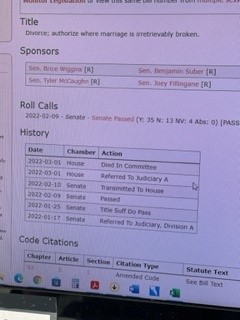
A proposed bill died a quiet death in committee yesterday, the same committee that helped in the drafting and promoting it. This bill had previously passed the Senate as well…

In November, I wrote about the “word on the street” of changes coming in Family Law in Mississippi. Last summer the Mississippi Legislature assembled a blue-ribbon panel of lawyers, judges, legislators, law professors and the like to assess some of Mississippi’s more difficult or out-of-the-main-stream family law laws.

This panel suggested multiple changes with child support/age of majority and adding a 13th ground for divorce- irretrievable breakdown. This change would bring Mississippi in line with approximately 48 other states.

Part of the reason for the blue-ribbon panel was to gain insight from the practitioners, judges and persons dealing with the families this would impact. The rumor mill was that this was a done deal, was much-needed and would alleviate what one supreme court justice described as “financial blackmail.”

Yoggi Berra said it first, “It ain’t over ’til it’s over.”

Senate Bill 2643 (Miss 2022) died in Committee on March 1, 2022, when it was referred to Judiciary A, by Speaker, Philip Gun.

“4   02/10 (S) Transmitted To House
   5   03/01 (H) Referred To Judiciary A
   6   03/01 (H) Died In Committee”

Unfortunately, we may never know all of the behind-the-scenes details on why this was studied, proposed, promoted, passed, referred and allowed to whither on the vine. But, it was a much needed change in Mississippi law and one that would do more to promote family harmony than anything else the Mississippi legislature could do.

This harkens back to 2017 when a legislator single-handedly killed attempts to add domestic violence as a specific element of a cruelty based divorce and allow for the victim’s testimony to be sufficient proof of such. Once the domestic violence provision was struck the firestorm that erupted caused an about-face of the legislator and the language reappeared in another bill…lets hope for some common sense and that history repeats itself.

Matthew Thompson is a Mississippi Divorce and Civil Defense Attorney and is routing for another Change of Heart!

Merry Christmas!!

(601)850-8000

Changes in Family Law Coming?? (for Mississippi)

Word on the street is that some changes are coming in family law in Mississippi…

Possible changes include;

Changing the age of majority from 21 to 19.

This change involves the time period a non-custodial parent would have to provide child support and certain other child related benefits. It could impact health insurance, extra curricular expenses and school expenses- unrelated to college. The vast majority of other states is 18 or 19 years of age- for age of majority.

Another change is adding a ground for divorce if your marriage is irretrievably broken.

Irretrievable breakdown means that the marriage is broken beyond repair, this quasi-no-fault ground tells a court that at least one spouse wants to end the marriage, which generally should be enough for a judge to grant a divorce.

This is a potentially significant change and would align Mississippi divorce law with 48 other states. This change would significantly streamline the current fault vs. consent requirements.

In June of 2021, the Mississippi Legislature established this task force to study Mississippi’s domestic relations laws and to develop recommendations to the Legislature and the Mississippi Supreme Court to recommend needed changes in MS Family Law.

Members of the task force included;

• Senate Judiciary A Chairman Brice Wiggins of Pascagoula and House Judicial A Chairman Angela Cockerham of Magnolia;
• Supreme Court Justice Kenneth Griffis of Ridgeland, Chancellor Troy Odom of Brandon and Chancellor Jennifer Schloegel of Gulfport, appointed by Supreme Court Chief Justice Mike Randolph;
• Court of Appeals Judge David Neil McCarty of Jackson, appointed by Court of Appeals Chief Judge Donna Barnes;
• attorneys Mark A. Chinn of Jackson, Donna S. Smith of Columbus, A. Regnal Blackledge of Collins and Diandra Hosey of Jackson, appointed by the Mississippi Bar;
• attorney guardians ad litem Melissa B. DiFatta of Pascagoula and Lee Ann Turner of Starkville, appointed by the Mississippi Bar;
• Division of Child Support Enforcement Senior Attorney J. Michael McCauley of Bay St. Louis, appointed by Mississippi Department of Human Services Executive Director Robert
G. Anderson;
• Professor Deborah Bell of Oxford, Senior Faculty in Service at the University of Mississippi School of Law, appointed by Dean Susan Duncan;
• Professor Shirley Kennedy of Jackson, Director of the Family and Children’s Law Center and Director of Child Advocacy Programs at Mississippi College School of Law, appointed by Dean Patricia Bennett.

Kudos to this fine group of lawyers, judges and academia for much needed changes in MS law.

Matthew Thompson is a family law and defense attorney in Mississippi and welcomes common sense changes in family law.