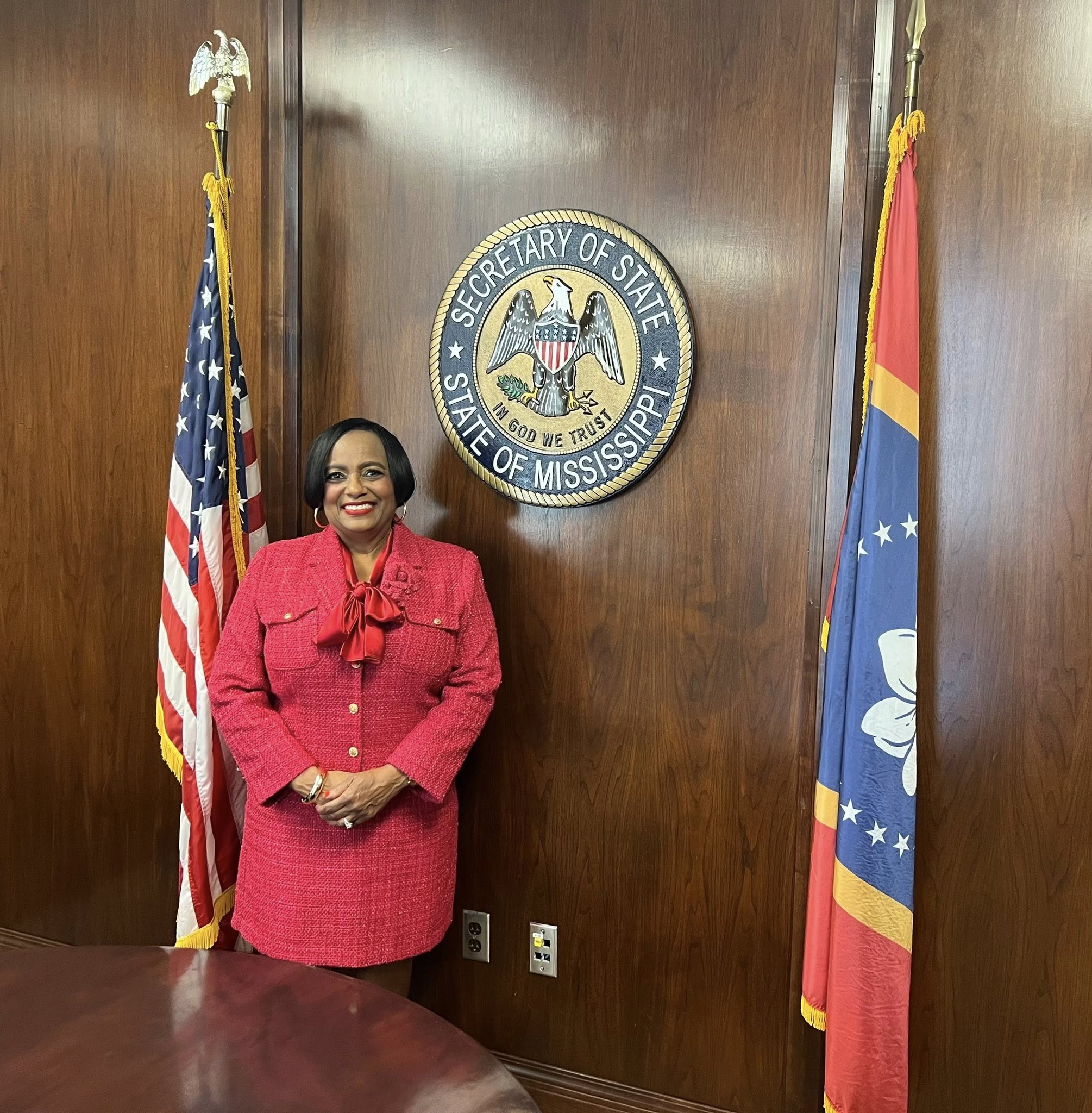
Hinds County Attorney, Bridgett Clayton, has qualified to run for Hinds County Chancery Judge!
“After much prayer and consideration, I am honored and excited to announce that I qualified for Hinds County Chancery Court Judge, District 5-3, on today.”
“I am ready to serve the citizens of Hinds County with God serving as a Lamp unto my feet and the Light unto my path as I seek election for this judicial seat to do justly, love mercy, and walk humbly before my God. Micah 6:8”
I am requesting your prayers and support during the campaign as well as on Election Day which is November 3.
Please be on the lookout for future campaign information. Thank You!
Matthew Thompson is a Chancery practitioner and knows-well the power, authority and responsibility that Chancellor’s have and the knowledge and wisdom they should possess. Attorney Bridgett Clayton has all of those qualities and then-some!
Please support Bridgett Clayton for Hinds County Chancellor!
Judges take an oath to uphold the Law. Most do, but some do not. The Code of Judicial Conduct are the standards for the ethical and professional conduct of judges.
So what do you do when the Judge rules against you?Sometimes it’s a judgment call and not a violation of the law. In these circumstances you can file a Motion for New Trial and/or an Appeal with the Mississippi Supreme Court.
But what about when the judge clearly violates the law? Can you sue the Judge? Usually, no. Judges have what is known as Judicial Immunity that protects them from civil liability for violating the law. If the actions are criminal there could be penalties, but typically not for civil violations.
However, if a Judge violates the Judicial Canons and violates your rights you do have options. What else can be done? You can Contact Mississippi Judicial Performance and file a COMPLAINT.
Judicial performance is an entity created by the Mississippi Constitution that seeks;
To enforce the standards of judicial conduct, To inquire into judicial liability and conduct, To protect the public from judicial misconduct and disabled judges, and To protect the judiciary from unfounded allegations.
All proceedings before the Commission are of a civil nature, not criminal, as the purpose of the Commission is to be rehabilitative and educational as well as disciplinary.
Any citizen, litigant, attorney, law enforcement official, judge, public official, or other individual who has knowledge of possible judicial misconduct may file a complaint with the Commission. Complaints may also be filed anonymously. Additionally, the Commission may file a complaint on its own motion based upon matters it learns of in other ways, such as from mass media and information obtained during the course of an investigation.
All complaints must be submitted to the Commission in writing. The Commission does not accept oral complaints. You may use a complaint form or write a letter to the Commission. A complaint form filed with the Commission should be typewritten or printed so that it is easily readable.
Complaints should include all information available regarding your case, the case number, Court it is in, the parties names, and any witnesses to the violation(s).
The complaint should include the specific conduct complained of and the violation alleged.
Matthew Thompson is an attorney in Mississippi and knows most Judges try to do it right…but for those that willfully do not do it right, Judicial Performance can address your concerns.
Senate Bill 2029, ( Sen. Brice Wiggins) proposes some common-sense change to Mississippi Family Law…for the umpteenth time in the last 20 years.
This Legislation proposes to add a 13th ground.
“Thirteenth. Upon application of either party, the court may grant a divorce when the court finds there has been an irretrievable breakdown of the marriage and that further attempts at reconciliation are impractical or futile and not in the best interests of the parties or family.“
This change would bring Mississippi in-line with 48 other states and Puerto Rico, all having true No-Fault divorce laws.
The other piece of this legislation eliminates the willful and obstinate aspects for abandonment and only requires “Continued * * * desertion for the space of one (1) year.”
These are common-sense changes in MS family law and would actually prevent protracted litigation and messy, expensive contests.
Matthew Thompson is a family law attorney and reminds you this Bill is contrary to the divorce attorney’s best interests and I am in support of these changes!
In what can only occur in our modern, social media-driven times, a North Carolina woman is found liable for breaking up a marriage and ordered to pay $1.75 million dollars to the wronged spouse. And her own TikTok videos were exhibits!!
Alienation of Affection allows the wronged spouse in a marriage to sue the “significant other” of the guilty spouse for the breakdown of the marriage. There are only 6 states in the country that still recognize AOA, but North Carolina and Mississippi are amongst them, and as recently as the 1990’s our Courts have refused to abolish this tort, reaffirming its place in the Mississippi legal system.
So what is AOA?
The elements are;
1) Wrongful Conduct (ie: adultery, though not required),
2) loss of affections, and
3) a causal connection.
All 3 must be present for a viable claim. There is a 3-year statute of limitations in which to bring the claim, beginning when the loss of affection is finally accomplished.
One of the issues that made this case especially egregious is that a tiktok video indicated that Brenay Kennard bought a pregnancy test after saying “I am getting down and dirty in the sheets.” At trial Kennard denied being sexually active at that time.
Another video featured Kennard saying, “I make her very uncomfortable.” Kennard admitted “her” referred to Akira Montague (the wife), but said “uncomfortable” could mean many things. She again denied being sexually active with Timothy Montague while he and Akira were together.
The jury did not buy it.
*As an aside, North Carolina has AOA and a separate tort called “criminal conversation” which only requires proof of sex with a married person for the “significant other” to be liable for damages. It does not require loss of affections or a causal connection or even a real relationship.
Thirteen years ago I typed these prophetic words, “So what is the take away here? Just because you are not married does not mean you have no culpability in an affair. You will be a necessary witness in the divorce case and stand a chance of getting sued yourself for AOA. And if you go to North Carolina, you better behave.“
$1.75 million dollars later and the above words are still true today!!
Matthew Thompson is a family law attorney in Mississippi and reminds you Alienation of Affection is alive and well and can make you pay!!
For years Doctors have enjoyed the saying “I’m sure your WebMD is just as good as my actual M.D….
Self-diagnosing running rampant…
Well now ChatGPT has made everyone a lawyer.
Need a brief in response to a summary judgment motion?
In mere seconds a fully typed, cited and “winning” brief is at your fingertips.
Only, there’s just one problem…
It’s fake! The cites are fake. The rulings are made up and the cases and courts may not even exist.
Recently BigLaw and small firms have been swept up in AI legal malfeasance. It’s making the rounds and the news.
A federal judge has even been the target of an inquiry when a ghost ruling appeared with fictitious parties, fake facts and bad law! The order vanished and was replaced with a corrected one.
So be careful out there. We can no longer believe the news, the internet or our own eyes.
Matthew Thompson is a family law attorney that cites Westlaw and text books, such as Mississippi Divorce, Alimony and Child Custody, with forms.
“I’ll take this all the way to the Supreme Court!”
A fair amount of family law cases are appealed in Mississippi. All are appealed to the Mississippi Supreme Court, most are assigned to the Mississippi Court of Appeals (COA). This means the COA will decide your appeal.
An appeal, typically, does not result in an outright win. Most appeals are denied, as the chancery courts in Mississippi have a tremendous amount of discretion. There must be a showing of abuse of discretion and/or manifest error for an appeal to be successful. But, even then it may only be a paper victory.
An appellate win usually results in a remand. Meaning sent back to the same Judge for a new hearing on the issue(s) that the lower Court got wrong, and it’s usually with instruction on what and how to try the matter.
This often results in delay, more court and frequently no actual change in the outcome. The other tough thing in family law appeals is that time marches on.
The appeal of a custody matter could look vastly different two-years later and the Court, while “correcting” the past error, cannot ignore the now-current circumstances.
Be carefully with appealing your case. Talk to your attorney about potential outcomes and whether or not it will change the result.
Matthew Thompson is a Mississippi appeals attorney and has participated in over 30 appeals.
These photos are still shots of a video taken at a recent Coldplay concert. A couple, caught up in a moment, got caught in the moment…allegedly.
Lead singer, Chris Martin is heard saying“Either they’re having an affair or they’re just very shy…Holy sh-t. I hope we didn’t do something bad,”
As the internet is known to do, online comments are all atwitter!
“Cost of a concert: Hotel $200, tickets $600, food/drinks $150, divorce attorney $50,000. Getting exposed by Coldplay having an affair with your co-worker: priceless,” wrote Instagram user Trustfundterry.







 (601) 850-8000 - - BowTieLawyer.MS