Category Archives: General Legal

Divorce Court vs. Criminal Court

Sometimes divorcing parties act like criminals, but Divorce Court is NOT Criminal Court (typically).

Divorce court, a.k.a. Chancery Court, is a civil court. The Court’s function is to legally divorce parties that are entitled to be divorced and divide property. The Court has the authority to deal with and punish conduct that is violative of its Orders or disruptive conduct that occurs directly in its presence. Other than those instances it is not a punitive Court. You typically are not punished for marital fault…

Criminal court, which can be Circuit, County, Municipal, or Justice, among others, can punish. These Courts have prosecutors whose job is to prove the accused committed a crime/violated a law. The Judge or a jury determines if the matter was proven and a punishment, including; incarceration, fines, and other remedies.

However, sometimes these can relate or overlap. Conduct that could serve as grounds for divorce, such as domestic violence, is also a crime. The Court’s are independent of one another and you can be punished in Criminal Court and divorced in Chancery Court over the same facts.

Interestingly, your right to plead the fifth, invoking the Fifth Amendment to the Constitution can be done in both Courts. While it cannot be used against you in Criminal Court, it can be used to make an adverse inference in Chancery Court. So, if you are accused of adultery/habitual fornication in Criminal Court, which IS a crime in Mississippi, you may invoke the fifth and the prosecutor must prove a violation of the law by beyond a reasonable doubt, however in Divorce Court, while you may invoke the fifth, the Court can treat that as an adverse inference/admission and could find such to be enough to rise to clear and convincing evidence of adultery. Confused yet?

Divorce Court and Criminal Court are different animals, with different standards and different outcomes. However, all are serious and your rights may be infringed if the Court determines they should be.

Matthew Thompson is a Divorce Court lawyer and encourages those charged with a crime to confer with an experienced Criminal Defense attorney.

Rule 11. Sanctions: Party or Attorney Misconduct

Sanction” is a penalty or punishment provided as a means of enforcing obedience to a law.  thelawdictionary.org

The Mississippi Rules of Civil Procedure, that all attorneys and parties have to abide by in litigation, include a specific rule that an attorney or a party may NOT file a motion that is frivolous or for the purpose of harassment or delay. M.R.C.P 11.

Frivolous” means a claim or defense made ‘without hope of success.’” See In re Spencer, 985 So. 2d 330, 338 (Miss. 2008). M.R.C.P 11

(b) Sanctions…For wilful violation of this rule an attorney may be subjected to appropriate disciplinary action. Similar action may be taken if scandalous or indecent matter is inserted. If any party files a motion or pleading which, in the opinion of the court, is frivolous or is filed for the purpose of harassment or delay, the court may order such a party, or his attorney, or both, to pay to the opposing party or parties the reasonable expenses incurred by such other parties and by their attorneys, including reasonable attorneys’ fees. [Amended effective March 13, 1991; amended effective January 16, 2003] M.R.C.P 11

Rule 11 provides two alternative grounds for the imposition of sanctions—the filing of a frivolous motion or pleading, and the filing of a motion or pleading for the purpose of harassment or delay. See Nationwide Mut. Ins. Co. v. Evans, 553 So. 2d 1117, 1120 (Miss. 1989). M.R.C.P 11

Although a finding of bad faith is necessary to sustain the imposition of sanctions based on purposeful harassment or delay, a finding of bad faith is not necessary to sustain the imposition of sanctions based upon frivolous pleadings or motions. M.R.C.P. 11.

A pleading is “frivolous” if its “insufficiency…is so manifest upon a bare inspection of the pleadings, that the court or judge is able to determine its character without argument or research.” In re Estate of Smith, 69 So. 3d 1, 6 (Miss. 2011). M.R.C.P 11

Sanctions against a party are improper in cases where the party relied strictly on advice of counsel and could not be expected to know whether the complaint was supported by law, where the party relied on advice of counsel in filing the pleading and played no significant role in prosecution of the action; or where the party was unaware and lacked responsibility for any bad faith harassment or delay. See Stevens v. Lake, 615 So. 2d 1177, 1184 (Miss. 1993). M.R.C.P 11

Let Rule 11 serve as a warning against filing things you know are untrue and/or that you cannot prove.

Matthew Thompson is a Chancery Court attorney in Mississippi and doesn’t often seek sanctions, but does when it’s warranted.

60 Days = Divorce?

Sixty days and you are divorced is NOT the law in Mississippi.

§ 93-5-2 – Divorce on ground of irreconcilable differences

“(4) Complaints for divorce on the ground of irreconcilable differences must have been on file for sixty (60) days before being heard... the provisions of Section 93-5-17 to the contrary notwithstanding.”

60 days is NOT a deadline. It is a minimum, mandatory waiting period. It provides sufficient time for a cooling-off period and typically sufficient time to do all of the things necessary to complete the paperwork required in an Irreconcilable Differences divorce.

You are NOT automatically divorced on day 60 or 61. It means that AFTER 60 days the completed paperwork may be presented to the Chancellor for their review and approval.

Additionally, all of the paperwork does NOT have to be completed before you file and the Court will keep the file open for at least 12 months with no additional activity. This means at any point after the initial filing and 60 days, a divorce may be presented and finalized.

Matthew Thompson is a “No Fault” divorce attorney in Mississippi.

MS Bar Exam: 3 strikes and back to law school

The Mississippi Supreme Court just enacted a new rule, effective 2020, for hopeful attorneys-to-be.

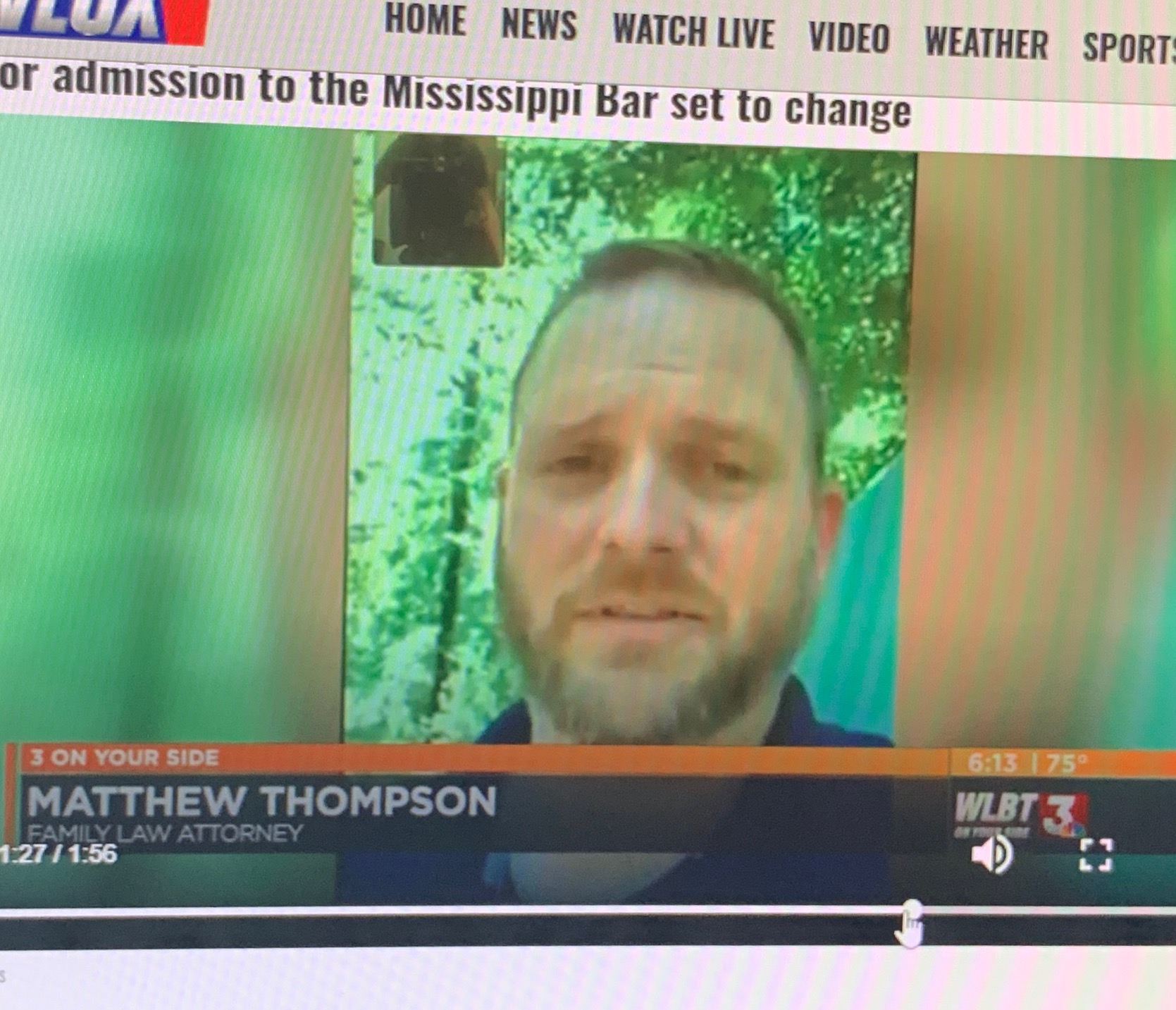
Matthew Thompson was interviewed by WLBT while attending Scout Camp regarding the new MS Bar Exam Rule change. It’s hard to take a good picture of a video…

There is now a rule regarding the number of times you may take the bar exam unsuccessfully before remedial education is mandatory. Upon 3 unsuccessful attempts, a test-taker must attend 12 additional hours of law school before sitting for the bar exam again.

Previously there was no set limit. Two Supreme Court Justices disagreed with the rule change, but not because it was too tough. One justice was in favor of a 3-strikes your’re out and another supported 5-strikes and you’re out.

There have been mixed responses to this rule change and the above link features area attorney’s reactions, including your truly.

Matthew Thompson is a Family Law attorney in Mississippi, passed the bar exam on his first attempt and if all goes to plan will not have to take another bar exam – – ever…

How to set yourself apart…

Lawyer advertising can still have a stigma attached to it. It’s a throw back to the “good ‘ol days,” I guess.

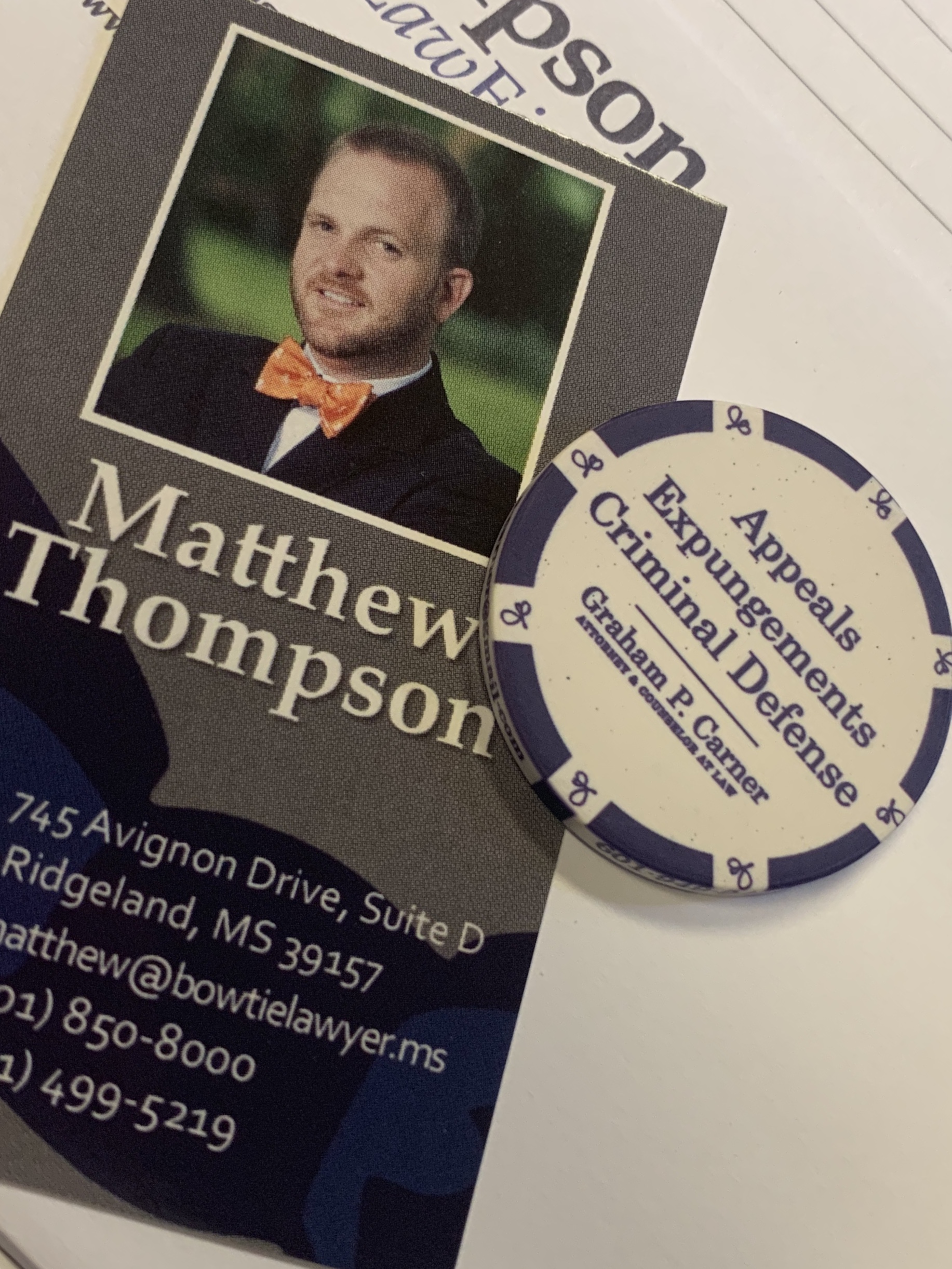
However, we all advertise, or market, in some way. The bow tie is a marketing tool. Well, today my friend Graham Carner gave me his “card.” It’s a poker chip. It says his practice areas, website and phone number. It’s also the first time I’ve seen a chip/card.

Kudos to Graham. Perhaps the bow tie bottle openers are not as far-fetched as I’ve been told!

Matthew Thompson is a family law attorney in Mississippi and is typically the only lawyer under 70 in a bow tie.

School records, grades and cooperation…

If you’re a parent you are entitled to your child’s school record, grades and information.

This is true regardless of the type of custody or visitation you have. This is true regardless of whether the other parent gives it to you or not. You are entitled to it by law in Mississippi. MCA 93-5-26

So, how do you get it?

  • Ask the other parent.
  • Ask the teacher.
  • Ask the guidance counselor.
  • Ask the principal.
  • Ask the guardian ad litem.
  • Formally request it in writing.
  • Have your lawyer request it.
  • and if all else fails
  • Issue a Subpoena.

Be nice, be professional, but be assertive.

The few exceptions to this are if your parental rights have been terminated and/or the child has been adopted or if there is a Court Order preventing you access.

Matthew Thompson is a Child custody lawyer in Mississippi and encourages you to be involved in your child’s schooling.

Matthew@bowtielawyer.ms (601)850-8000

An Apple a Day…

“An apple a day keeps the Doctor away,” may be getting replaced with an “Apple today keeps the Divorce attorney away!”

Your iPhone is NOT great at keeping secrets. All calls, texts and emails are trackable, if not recoverable. It links to the Cloud and backs up your photographs, even the ones you delete. It knows what apps you have downloaded, it knows when you are sleeping, it knows when you’re awake, it knows when you’ve been good or bad…

So, what can you do? You can upgrade your device. If there is no case pending, no request to preserve evidence, no issued subpoena or a discovery request, you can get rid of it.

What did Tom Brady do? He got rid of it.

What did Hillary Clinton do? She got rid of it.

What did Nevada Barr do? She “took a cold chisel and a hatchet; I tore it apart; I then took all of the pieces that were inside of it and I put them in the metal box; I burned it by pouring gasoline over it, and I shoveled it into a plastic bag and I dumped it in a bayou.

Matthew Thompson is a Family Law attorney in Mississippi and does NOT advise the spoliation of evidence, obstruction of justice or Russian collusion, but you can upgrade your cell phone or laptop.

Attorney Malpractice vs. Misconduct

Dreaded words! “I’ll report you to the Bar!” or “I’ll sue you!”

Attorney Malpractice

“Not every mistake made by an attorney is considered legal malpractice. Instead, legal malpractice happens when an attorney handles a case inappropriately due to negligence or with intent to harm and causes damages to a client. To prevail in a legal malpractice lawsuit in most jurisdictions, you will need to prove an attorney-client relationship between you and the lawyer, a breach of the duty to provide skillful and competent representation (negligence), causation, and a financial/tangible loss. “
https://www.justia.com/injury/legal-malpractice/

In Mississippi, in most instances, you have to show but for the malpractice you would have won your case, known colloquially as trying a case within a case.

Malpractice may give rise to a lawsuit against your lawyer. This would NOT be handled by the Mississippi Bar and would NOT be handled through a Bar Complaint. Instead, you would hire another lawyer, hopefully experienced in these types of matters, and would require you proving the above elements for attorney malpractice.

The usual litigation process would apply and you can count on a defense. A three year statute of limitations applies to attorney malpractice.

Additionally, malpractice is different than attorney discipline or a Bar Complaint.

Attorney Misconduct

Misconduct includes a violation of the Mississippi Rules of Professional Conduct. This is evaluated by the Mississippi Bar and eventually the Mississippi Supreme Court, if a serious violation is deemed to have occurred.

The MS Bar website has a thorough Q&A section on Attorney Misconduct/Bar Discipline. Selected excerpts included below;

What is the statute of limitations for conduct that is the subject of a Bar complaint?

Generally, the statute of limitations is three years after discovery of the facts that give rise to the Bar complaint.  There are some exceptions.  There is no statute of limitations for conduct that violates Rules 1.15, 8.1 and 8.4 of the Mississippi Rules of Professional Conduct.  See Rule 4(d) of the Rules of Discipline for the Mississippi State Bar.

Is the Bar complaint process confidential?

All Bar personnel and members of the Committee on Professional Responsibility are charged with maintaining the confidentiality of the Bar complaint process.  This means Bar personnel can neither confirm nor deny the existence of any Bar complaint.  However, this prohibition does not apply to the attorney, the complainant or any other witness.  The confidential nature of the Bar complaint process ends if the attorney makes any public statement, public discipline is imposed or a Formal Complaint is filed.  See Rule 15 of the Rules of Discipline for the Mississippi Bar.

Who do I contact to complain about an attorney?

If you are concerned that your attorney or an attorney you have come in contact with may have committed an ethics violation you may contact the Consumer Assistance Program (CAP) to inquire about the possibility of filing a Bar Complaint.  CAP may be contacted by telephone at (601) 948-2344; by email at gwaddle@msbar.org; or by mail:

Consumer Assistance Program
Post Office Box 2168
Jackson, Mississippi 39225-2168

Who considers my Bar complaint?

The Committee on Professional Responsibility acts as a grand jury of sorts.  It considers each Bar complaint to determine whether there is proof of an ethics violation.  If the Committee determines there is sufficient proof of a violation, they may impose discipline in the form of an Informal Admonition, Private Reprimand or Public Reprimand.  If the Committee determines that the ethics violation is so serious that it deserves more than a Public Reprimand, they may direct General Counsel to file a Formal Complaint with the Supreme Court of Mississippi. 

Does a complainant have to be a client or former client to file a Bar complaint?

No. The Rules of Discipline for the Mississippi State Bar provides that acts or omissions by an attorney that violate the Rules of Professional Conduct are grounds for discipline regardless of whether those acts or omissions occurred in the context of an attorney-client relationship. 

What is a Formal Complaint?

A Formal Complaint is filed at the direction of the Committee on Professional Responsibility or as a result of the attorney appealing the discipline imposed by the Committee.   Formal Complaints are public record and are filed with the Clerk of the Supreme Court of Mississippi.  Once a Formal Complaint is filed, the Supreme Court designates a Complaint Tribunal to hear and determine the matter.  A Complaint Tribunal can dismiss the Formal Complaint or impose discipline in the form of a Private Reprimand, Public Reprimand, Suspension of Disbarment.  The attorney or the Bar may appeal the decision of a Complaint Tribunal within 30 days to the Supreme Court of Mississippi. See Rules 8 and 9 of the Rules of Discipline for the Mississippi State Bar.

How does a suspended or disbarred attorney seek reinstatement to the practice of law?

Attorneys suspended for less than 6 months are reinstated upon the expiration of the time imposed and the satisfaction of any conditions of the suspension order.  Attorneys suspended for 6 months or more or disbarred must petition the Supreme Court of Mississippi for reinstatement and follow the dictates of Rule 12 of the Rules of Discipline for the Mississippi State Bar.  Attorneys disbarred due to a felony conviction after April 4, 2002, are not eligible for reinstatement to the practice of law. 

The hyperlinks above will take you to the source page and includes additional information.