Hinds County Attorney, Bridgett Clayton, has qualified to run for Hinds County Chancery Judge!
“After much prayer and consideration, I am honored and excited to announce that I qualified for Hinds County Chancery Court Judge, District 5-3, on today.”
“I am ready to serve the citizens of Hinds County with God serving as a Lamp unto my feet and the Light unto my path as I seek election for this judicial seat to do justly, love mercy, and walk humbly before my God. Micah 6:8”
I am requesting your prayers and support during the campaign as well as on Election Day which is November 3.
Please be on the lookout for future campaign information. Thank You!
Matthew Thompson is a Chancery practitioner and knows-well the power, authority and responsibility that Chancellor’s have and the knowledge and wisdom they should possess. Attorney Bridgett Clayton has all of those qualities and then-some!
Please support Bridgett Clayton for Hinds County Chancellor!
In 2023, the Mississippi Legislature enacted changes in child welfare, enacting a Foster Parents’ Bill of Rights. But, what does this mean…? Stay tuned for a multi-part blog diving into the FPBOR and what it means AND what it doesn’t mean…
Foster Parents’ Bill of Rights and Responsibilities
The Department of Child Protection Services shall extend the following rights to persons who provide foster care and relative care:
(a) A clear understanding of their role while providing care and the roles of the birth parent(s) and the placement agency in respect to the child in care;
(b) Respect, consideration, trust and value as a family who is making an important contribution to the agency’s objectives;
(c) Notification of benchmarks that will be required of the foster parent such as appointments, home visits with department personnel, visitations of the child at school and meetings between department personnel and the child’s family;
(d) Advance notice of information regarding scheduled meetings other than meetings where the Department of Child Protection Services personnel or social workers are going to the foster parent’s home for site visits, appointments and court hearings concerning the foster child;
(e) The opportunity to communicate with professionals who work with the foster child including therapists, physicians and teachers who work directly with the child;
(f) The opportunity to communicate and collaborate, without threat of reprisal, with a department representative when further educational services are needed to ensure the child’s educational needs are met, including services such as an Individualized Educational Plan (IEP), tutoring, occupational therapy, speech therapy and after-school programs;
(g) The opportunity to attend all IEP meetings, along with the department worker, at the child’s school as long as the child is in custody and receiving special educational services;
(h) The opportunity to communicate with the foster child’s guardian ad litem;
(i) The opportunity to attend all youth court hearings involving a foster child occurring while that child is placed in their care without being a party to the youth court action, unless the youth court determines that any foster parent should not be present. Foster parents may attend all youth court hearings and have legal counsel attend and observe with them if the child’s permanent plan is adoption by the foster parents, unless the youth court determines that any foster parent should not be present. Foster parents may communicate with the guardian ad litem in writing at any time. Foster parents may ask to be heard concerning the best interest of the child at any disposition or permanency hearing;
(j) When the dates of the permanency hearing and permanency review hearing have been set by the youth court, and if necessary to fulfill the notice requirements, the judge or the judge’s designee shall order the clerk of the youth court to issue a summons to the foster parents to appear personally at the hearings as provided by Section 43-21-501;
(k) The opportunity to request from the youth court permission to communicate with the child’s birth family, previous foster parents of the child, and prospective and finalized adoptive parents of the child, without the threat of reprisal. However, this right creates no obligation of the birth family, previous foster parents, or prospective and finalized adoptive parents to communicate in return;
(l) Involvement in all the agency’s crucial decisions regarding the child as team members who have pertinent information based on their day-to-day knowledge of the child in care and involvement in planning, including, but not limited to, individual service planning meetings, foster care review, individual educational planning meetings, and medical appointments;
(m) The opportunity to participate in the planning of visitations between the child and the child’s siblings, parents or former guardians or other biological family members which have been previously authorized by the youth court. Visitations shall be scheduled at a time and place meeting the needs of the child, the biological family, and the foster family.
Recognizing that visitation with family members is an important right of children in foster care, foster parents shall be flexible and cooperative with regard to family visits but shall retain the right to reasonable advance notice of all scheduled visitations;
(n) The ability to communicate with department personnel or representatives twenty-four (24) hours a day, seven (7) days a week, for the purpose of aiding the foster parent;
(o) A comprehensive list of all resources available to the foster parent and child, including dental providers, medical providers, respite workers in the area, day cares, and methods for submitting reimbursements;
(p) Support from the family protection worker or the family protection specialist in efforts to do a better day-to-day job in caring for the child and in working to achieve the agency’s objectives for the child and the birth family through provision of:
(i) A copy of the “Foster Child Information Form” and all other pertinent information about the child and the birth family, including medical, dental, behavioral health history, psychological information, educational status, cultural and family background, and other issues relevant to the child which are known to the department at the time the child is placed in foster care prior to the child’s placement with a foster parent or parents. The department shall make reasonable efforts to gather and provide all additional current medical, dental, behavioral, educational and psychological information reasonably available from the child’s service providers within fifteen (15) days of placement. When the department learns of such information after fifteen (15) days of placement, the department shall communicate such information to the foster parent as soon as practicable;
(ii) An explanation of the plan for placement of the child in the foster parent’s home and the ongoing and timely communication of any necessary information which is relevant to the care of the child, including any changes in the case plan;
(iii) Help in using appropriate resources to meet the child’s needs, including counseling or other services for victims of commercial sexual exploitation or human trafficking;
(iv) Direct interviews between the family protection worker or specialist and the child, previously discussed and understood by the foster parents;
(v) Information regarding whether the child experienced commercial sexual exploitation or human trafficking;
(vi) Information related to the Healthy, Hunger-Free Kids Act of 2010. Foster parents shall protect the confidentiality of the child by working directly with a designated school official to complete the application for free lunches.
(q) The opportunity to develop confidence in making day-to-day decisions in regard to the child;
(r) The opportunity to learn and grow in their vocation through planned education in caring for the child;
(s) The opportunity to be heard regarding agency practices that they may question;
(t) Information related to all costs eligible for reimbursement, including:
(i) Reimbursement for costs of the child’s care in the form of a board payment based on the age of the child as prescribed in Section 43-15-17 unless the relative is exempt from foster care training and chooses to exercise the exemption; and
(ii) Reimbursement for property damages caused by children in the custody of the Department of Child Protection Services in an amount not to exceed Five Hundred Dollars ($500.00), as evidenced by written documentation.
The Department of Child Protection Services shall not incur liability for any damages as a result of providing this reimbursement.
(12) The Department of Child Protection Services shall require the following responsibilities from participating persons who provide foster care and relative care:
(a) Understanding the department’s function in regard to the foster care and relative care program and related social service programs;
(b) Sharing with the department any information which may contribute to the care of children;
(c) Functioning within the established goals and objectives to improve the general welfare of the child;
(d) Recognizing the problems in home placement that will require professional advice and assistance and that such help should be utilized to its full potential;
(e) Recognizing that the family who cares for the child will be one of the primary resources for preparing a child for any future plans that are made, including return to birth parent(s), termination of parental rights or reinstitutionalization;
(f) Expressing their views of agency practices which relate to the child with the appropriate staff member;
(g) Understanding that all information shared with the persons who provide foster care or relative care about the child and his/her birth parent(s) must be held in the strictest of confidence;
(h) Cooperating with any plan to reunite the child with his birth family and work with the birth family to achieve this goal; and
(i) Attending dispositional review hearings and termination of parental rights hearings conducted by a court of competent jurisdiction, or providing their recommendations to the guardian ad litem in writing.
(13) The department shall develop a grievance procedure for foster parents to raise any complaints or concerns regarding the provisions of Section 43-15-13(11) or (12).
(14) Nothing in this section shall be construed to create a private right of action or claim on the part of any individual, the department, or any child-placing agency.
Matthew Thompson is a child custody attorney in Mississippi and routinely presents at Guardian Ad Litem training and has presented at Foster Parent Training.
Believe it or not, there are not many Mississippi Legislators that are lawyers!
Saturday Night Live compared the Mississippi Legislature to a hissing possum. It was funny…
“Whew!” you say? Not so fast. Our legislators make the laws. This may be the one instance more lawyers could help!!
There is proposed legislation with terminology, words, that do not mean what you (and our legislators) think they mean. Words matter. Legal words matter.
There’s a marked difference between May and Shall in the eyes of the law.
So, legislators, Please contact me at any time about any questions regarding proposed legislation. If i have an opinion I will share it. If I am unqualified to comment I will admit it, and if you ask that our discussion remain confidential I will honor that.
Let’s get this right the first time. Its too important to not to.
Matthew Thompson is a 20-year practicing lawyer, law school professor, author of the family law text book in Mississippi and not afraid to speak out and speak up. Contact him via email or phone. Matthew@ThompsonLaw.ms or (601)850-8000
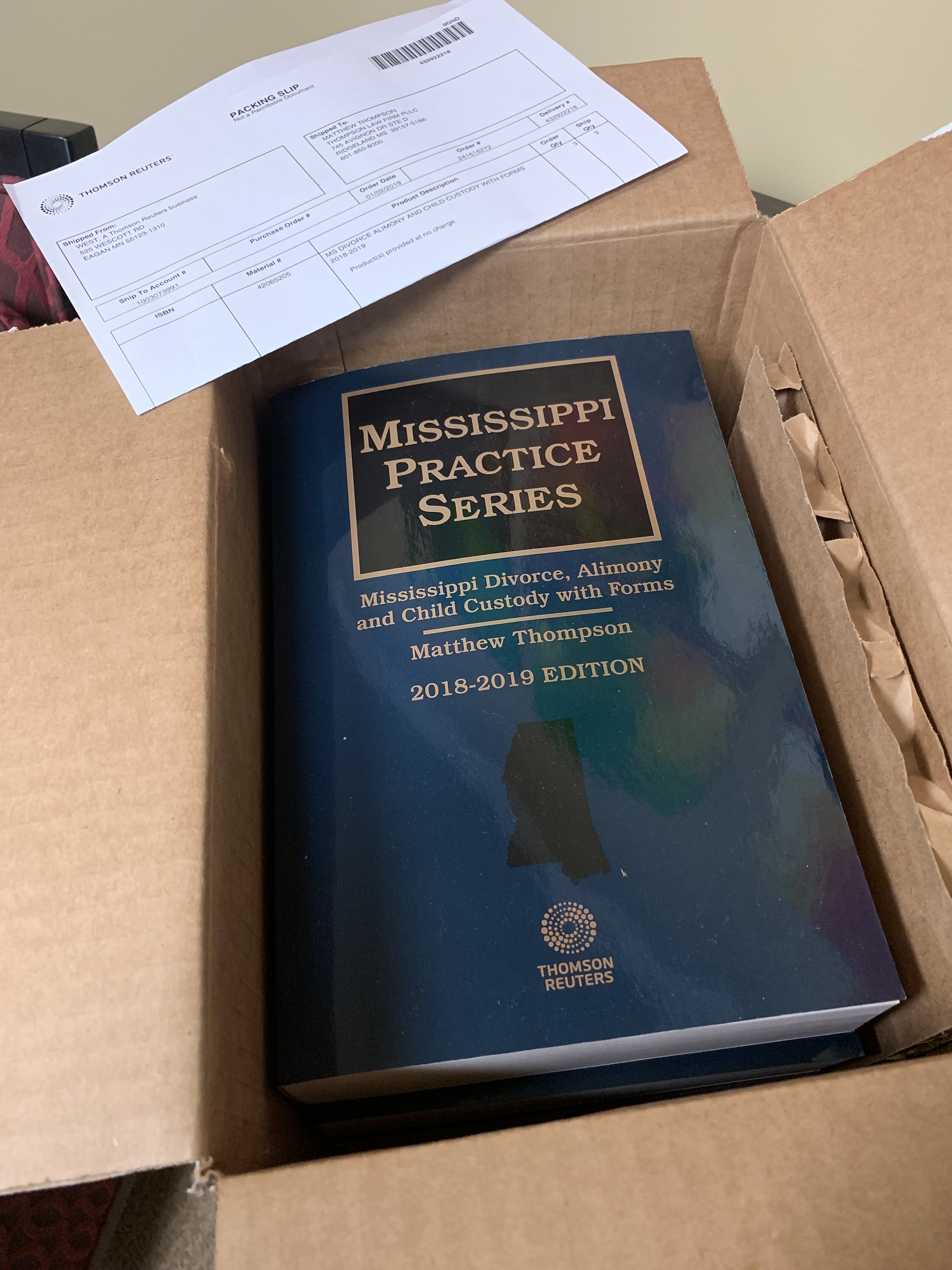
This edition, in addition to bedrock family law principles, includes statutory and case law updates regarding jurisdiction, alimony, equitable division, business valuation, contempt, attorney fees, visitation, custody and de facto marriage concerns. It also includes updated, revised and new forms.
Matthew Thompson is a Family Law practitioner in Mississippi and has been the author of Mississippi Divorce, Alimony and Child Custody with Forms, since taking the reigns from his now retired Law School professor, the venerable Shelton Hand.
Judges make mistakes, witnesses remember it wrong and you may ask for improper relief. But, all is not lost. You have options.
Motion for New Trial. This motion, sometimes referred to as a motion for reconsideration, can provide an avenue for the Judge to correct the mistake. They must be filed within 10 days of the Final Judgment and they are not for a do-over, but to correct a clear error of law or fact.
Appeal. You may appeal any Final Judgment. You have 30 days to do so from the final ruling and if you do a timely Motion for New Trial it resets the appeal clock. Appeals can be cumbersome and daunting. These are to the appellate court, not the Court that decided your case. However, an appeal is based on what happened below, the trial record. It’s not for new happenings.
If you are the parent to a child then act like it.
We have seen the reports and stories of parents going off the deep end. Using illegal drugs, abusing substances, pursuing bad-idea relationships and ultimately putting their own selfish desires above the needs of their children. It’s time to stop.
There are only a handful of people that you, as a parent, are ultimately responsible for; yourself and the people you brought into this world, your children.
Don’t shirk your duties. Don’t neglect your children. Don’t be so consumed with your own desires that you lose sight of what is important. Don’t hate another person so much it clouds your judgment when it comes to your children.
Matthew Thompson is a Child Custody attorney and encourages parents to grow up and act like a parent.
Please see our article appearing in this month’s edition of The Mississippi Lawyer magazine. It’s reproduced below for your convenience.
Many times we have clients call regarding a divorce and have common misconceptions because “that’s what they have heard.” Just because your friend’s neighbor went through a divorce does not mean that what they experienced applies to your case. Also, as all cases are uniquely different, your case is not guaranteed to be like theirs.
I’m filing for a no fault divorce. Mississippi is not a true “no fault” state. At this time, one party cannot file for a no fault divorce in Mississippi. Both parties may file for a divorce on Irreconcilable Differences, keyword “both” parties. This filing is usually a Joint Complaint for Divorce, which also requires that both parties have entered into an Agreement for the custody, support and maintenance of the minor child(ren) and the settlement of all property rights.
An affair means you can’t have custody. False. When determining custody, the Court relies on the Albright factors. Albright vs. Albright, 437 So. 2d 1003 (Miss 1983). One of the factor is the moral fitness of the parents, this is where the Court could consider any fault or misconduct on the parties. The court has stated “marital fault should not be used as a sanction in custody awards.” Carr, 480 So.2d at 1123. Where both parties engage in extramarital affairs, neither should get the benefit of a finding of moral fitness. Fulk v. Fulk, 827 So.2d 736, 740(¶ 15) (Miss.Ct.App.2002).
A court should determine custody and the best interests of the child by looking at the following factors:
Age of the child.
Health of the child.
Sex of the child.
Continuity of care prior to the separation.
Which parent has the better parenting skills and the willingness and capacity to provide primary child care.
The employment of the parent and the responsibilities of that employment.
Physical and mental health and age of the parents.
Emotional ties of parent and child.
Moral fitness of the parents.
The home, community and school record of the child.
The preference of the child at the age sufficient to express a preference by law. (Must be at least 12, and it’s ONLY a preference)
Stability of home environment and employment of each parent.
Other factors relevant to the parent-child relationship.
The woman always gets custody. False. Miss. Code Ann. §93-5-24(7) states: “There shall be no presumption that it is in the best interest of a child that a mother be awarded either legal or physical custody.” Some lawyers may be screaming at this article, “what about the tender-years doctrine??” In Rosser v. Morris, the Court of Appeals affirmed the trial court’s decision of the mother being granted custody and during an analysis of Albright stated, “Although the tender-years doctrine was ” significantly weakened” by section 93-5-24(7), ” there is still a presumption that a mother is generally better suited to raise a young child.” Passmore v. Passmore, 820 So.2d 747, 750 (¶ 9) (Miss. Ct. App. 2002), 135 So.3d 945 (2014). The lower court found that since the father had played an active role in changing diapers, bath times, and games that the factor of the age, health and sex of the child favored neither parent.
Once a child is twelve, he/she can decide where they want to live. This is simply not true. When making a custody determination the Court considers ALL of the Albright factors. The applicable statute, Mississippi Code Annotated section 93-11-65(1)(a) (Supp.2006), states ” the chancellor may consider the preference of a child of twelve (12) years of age or older as to the parent with whom the child would prefer to live in determining what would be in the best interest and welfare of the child. The chancellor shall place on the record the reason or reasons for which the award of custody was made and explain in detail why the wishes of any child were or were not honored.” (Emphasis added.) Phillips v. Phillips, 45 So.3d 684 (2010). One of the factors includes the preference of the child over the age of 12, but this one factor alone does not carry the day. The child’s preference is not outcome determinant. Holmes v. Holmes, 958 So.2d 844, 848 (¶ 15) (Miss.Ct.App.2007) That being said, as a child reaches certain, more mature ages, the Court may be more inclined to adopt the child’s preference.
“Take you to the cleaners” Mississippi is an equitable distribution state. Equitable distribution does not mean 50/50, but it also does not mean 100/0. The court has laid out several factors known as the “Ferguson Factors” when it comes to equitable distribution. Ferguson vs. Ferguson, 639 So.2d 921, 928-9 (Miss. 1994). The enumerated factors are as follows:
Direct or indirect economic contribution to the acquisition of the property;
Contribution to the stability and harmony of the marital and family relationships as measured by quality, quantity of time spent on family duties and duration of the marriage; and
Contribution to the education, training or other accomplishment bearing on the earning power of the spouse accumulating the assets.
Tax and other economic consequences, and contractual or legal consequences to third parties, of the proposed distribution;
The extent to which property division may, with equity to both parties, be utilized to eliminate periodic payments and other potential sources of future friction between the parties;
The needs of the parties for financial security with due regard to the combination of assets, income and earning capacity; and,
Any other factor which in equity should be considered.“
Mississippi is not an alimony state. Mississippi is an alimony state. The court has laid out several factors known as the “Armstrong Factors” when determining whether or not alimony is appropriate. Armstrong vs. Armstrong, 618 So.2d 1278, 1280 (Miss. 1993).
It is important to note the Court has directed that alimony is to be used after an equitable distribution of the marital estate. If the court finds that the needs of both parties are met and there is no disparity with the distribution of the marital estate, the court does not consider alimony.
1) The first factor is the income and expenses of the parties. When there is a great disparity in the earning capacity and incomes of the parties it could support an award of Alimony.
2) The second factor is the health and earning capacities of the parties. This considers physical and mental health, as well as earning capacity, to include degrees, etc…
3) Third, the court is to consider the needs of each party. The living expenses.
4) Fourth, the court is to consider the obligations and assets of the parties. Is the marital estate encumbered by a significant debt? Is a party living off his credit card?
5) The fifth factor to consider is the length of the marriage. Less than 10 years is not long. 20 years and over is long. Between 10-20 is the gray area. Of course, it’s all gray and it’s possible to get alimony in very short marriages and not get it in very long marriages.
6) The sixth factor is the presence or absence of minor children in the home.
7) The seventh factor is the age of the parties. Think years left for gainful employment and to live…
8) The eighth factor is the parties’ standard of living, both during the marriage and at the time of the support determination. Have the Parties enjoyed a relatively high standard of living in comparison to most? Allowing them to take trips, to purchase recreational vehicles, to purchase a half a million dollar home in the suburbs, to send their children to private school, and have not had to be concerned about money or curb their spending during times when husband was not working?
9) The ninth factor to consider is the tax consequences of the spousal support. Alimony payments, normally,would be taxable income to the receiver and deductible to the payor, allowing her to receive a tax benefit in the reduction of her taxable income for the duration of the support payments. It’s also possible to make it non-taxable, depending upon the duration of the payments and whether same is owed in the event the payor dies.
10) The tenth factor is fault or misconduct. Fault grounds; adultery, cruelty, etc…
11) The eleventh factor is wasteful dissipation of assets by either party. Booze, drugs, or gambling spending.
12) The final factor for the court’s consideration is any other factor deemed by the court to be “just and equitable” in connection with the setting of spousal support. So any other compelling reason in favor of alimony.
After weighing each of the factors set forth in Armstrong v. Armstrong, 618 So.2d 1278, 1280 (Miss. 1993), and viewing the totality of the circumstances, the court will find whether an award of alimony is warranted.
The man has to provide health insurance. False. At first I thought this was a joke, but I have heard it enough times to include it in this list. There is no authority that a male is required by law to provide health insurance. This usually comes up in child support issues. Miss. Code Ann. §43-19-101 (6) states:
(6) All orders involving support of minor children, as a matter of law, shall include reasonable medical support. Notice to the obligated parent’s employer that medical support has been ordered shall be on a form as prescribed by the Department of Human Services. In any case in which the support of any child is involved, the court shall make the following findings either on the record or in the judgment:
(a) The availability to all parties of health insurance coverage for the child(ren);
(b) The cost of health insurance coverage to all parties.
The court shall then make appropriate provisions in the judgment for the provision of health insurance coverage for the child(ren) in the manner that is in the best interests of the child(ren). If the court requires the custodial parent to obtain the coverage then its cost shall be taken into account in establishing the child support award. If the court determines that health insurance coverage is not available to any party or that it is not available to either party at a cost that is reasonable as compared to the income of the parties, then the court shall make specific findings as to such either on the record or in the judgment. In that event, the court shall make appropriate provisions in the judgment for the payment of medical expenses of the child(ren) in the absence of health insurance coverage.
If we have joint custody, that means I do not have to pay child support. False. Child Support can still be awarded within the Chancellor’s discretion under the statute. Chancellors can evaluate the expenses of the child, the difference in wage and earning capacity of the parties’ to determine whether child support would be appropriate.
Common misconceptions abound and include more than just the topics included here. Friends and the internet can be a valuable resource, but they can also be dangerous to rely upon. Instead, rely upon your attorney. Ask the question even if you think you know the answer. Do not let these Family Law faux pas trip you up.
By Matthew Thompson & Chad King
Matthew Thompson & Chad King are attorneys with Thompson Law Firm. If you have questions regarding a Family Law matter, or any other legal issue, you may call to have your questions answered or for an appropriate referral at (601)850-8000.







 (601) 850-8000 - - BowTieLawyer.MS