Attorneys are easy targets for social media/rating review site criticism.
Sure, we can pay $450.00 dollars and get a plaque that says we are the Top Ten Bestest Attorneys in the Universe, but it’s easy for anyone to put hate out there too.
Yelp reviews, Facebook comments and all the other review/rating websites make it very easy to attack.
Ever wonder why reviews go largely unresponded to, or at best some generic, canned PC response?
It’s because lawyers can get in trouble for telling the truth!!
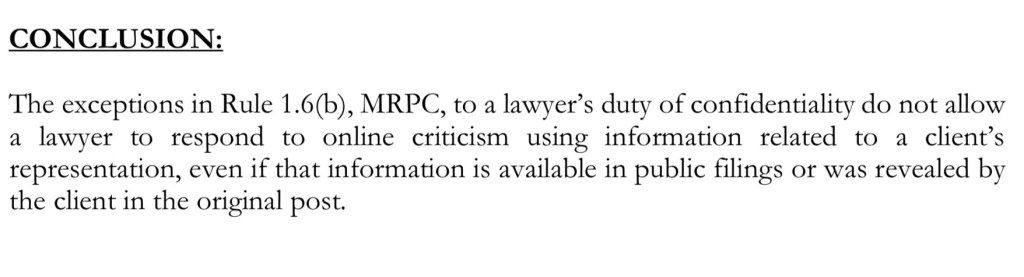
A recent Mississippi Bar Opinion even opines it an ethical violation to respond to an online complaint.
This, even if the client (now former client) makes the posting and discloses confidential information. They have the right to do that. The attorney in only limited circumstances can respond…
So just because you see a review doesn’t make it true. And, just because it was NOT immediately challenged with “receipts” doesn’t mean there’s something there.
Matthew Thompson is a lawyer that represents other lawyers with accusations of ethical violations.
The internet is truly the wild west of modern day society. Social media, electronic communications and instant access have made daily life easier and more painful!
Hacked= use a computer to gain unauthorized access to data in a system.
Cloned=cloning the process of copying the contents of one computer hard drive to another disk or to an “image” file.
Spoofed= Spoofing is a type of scam in which a criminal disguises an email address, display name, phone number, text message, or website URL to convince a target that they are interacting with a known, trusted source. Spoofing often involves changing just one letter, number, or symbol of the communication so that it looks valid at a quick glance. For example, you could receive an email that appears to be from Netflix using the fake domain name “netffix.com.”
Phishing= the fraudulent practice of sending emails or other messages purporting to be from reputable companies in order to induce individuals to reveal personal information, such as passwords and credit card numbers.
I have been a victim twice in the last 6-months!
6 months ago my Facebook was hacked. The hacker, from exotic Thailand, began attempting to login multiple times and then managed to change the recovery email to their own. Facebook, clearly confused that I may be in Thailand, allowed my new friend access and allowed them to be me! They immediately sent 100s of friend requests and did mainly other mildly annoying things, but no real damage. Or so I thought…
It turns out what the hacker was doing was buying ads for some dumb game/virus scam. Even after I was able to recover my account I was unaware that my Thai-buddy purchased Facebook ads with my credit!
Facebook sent me a notice of how my ad campaign was going. I advised Facebook that I had no such campaign. Turns out I had 3! One active and 2 in the hopper. I was able to end the current ad and delete the future ads, with minimal actual out of pocket expense to me. When I reported this to Facebook, they stated they reviewed the campaign and it all looked legit so I could not get my money back. Whomp-whomp.
However, I was able to regain control, detach a payment source and ultimately minimize the harm. It wasn’t super easy or straight forward and I felt as if Facebook thought I was up to something as opposed to the Thai-user.
Well, this week, my email account was hacked. This time my friend traveled to Lagos, Nigeria. They began login attempts at 6 in the morning and gained access at 2 in the afternoon. Now why Outlook doesn’t think every attempt to login to my email from Nigeria isn’t suspect is beyond me. A review of “My Activity” shows numerous logins from good ‘ol Madison, Mississippi for years and then a few hours later Nigeria!
Outlook’s assumption? I must be in Nigeria and need access. And I forgot my long-in and password… The Nigerian interloper gained access for a few minutes, sent out 180 emails with an attachment that looked like a Word download of a Bed Bath and Beyond Coupon and I immediately started getting calls, texts, and emails asking “Is this legit?“
As I responded as fast I could “No!” The hacker was responding “Yes. Please download.” !!! The hacker then started deleting my sent mail so I could not warn all persons it was sent to. I was finally able to wrestle back my email and changed the credentials to a password no human can ever remember…
This hack made less sense to me, but it turns out they targeted a law firm in the hopes of getting access to the lawyer’s trust/escrow account. They failed. This time.
Just for fun, the Hacker also implemented a “Rule” within my Email that rerouted all incoming messages to a subfolder that was previously never used. It took an expert diagnosis to solve that conundrum and the explanation of why incoming messages were rerouted was so that I would quit responding to persons that it was a scam.
This was also during the Snowapocolpyse of 2024. Perfect timing.
So what are the takeaways? Have some good antivirus software on your computer. Have some good passwords that are hard to guess. Have a recovery email go somewhere that you will have access to it. Get a credit card that is exclusively for online purchases. Get a bank account, again, solely for online activity. This will not prevent any hacking, but it will minimize the damage.
Matthew Thompson is a family law attorney in Mississippi and cautions you to be careful with downloads, uploads and computer users from Thailand and Nigeria.
In 2016, a mother sought sole custody and child support in a modification action against the father. After a two-day evidentiary trial, the Judge gave the parties 10 days to submit proposals on how the Court should rule. After these submissions, but prior to the Court ruling the Judge accepted the mother’s Facebook friend request. This was unknown to the father.
While awaiting a decision, the mother liked 18 of the Judge’s “Facebook posts and commented on two of them.” However, the Judge did not like or comment on any of the mother’s posts, though he did not deny reading them.
In July, the Judge ruled in favor of the mother. That same day, the guardian ad litem for the child learned that the mother had posted on Facebook that “the Honorable Judge granted everything we requested” and then discovered the mother and Judge were Facebook friends.
The father filed a motion to reconsider, arguing the Facebook frienship created the appearance of impropriety. The Court ruled that he’d made up phis mind prior to the request and denied the father’s motion.
The Wisconsin Appellate Court found that these circumstances clearly created the appearance of impropriety.
The mother’s friend request, and the Judge’s acceptance just prior to a decision “conveys the impression that [the mother] was in a special position to influence [the] Judge’s ultimate decision — a position not available to individuals that he had not ‘friended,’ such as [the father].
The appellate court did state that the “decision does not reach the merits of… [the] ultimate decision on [the mother’s] motion, and we recognize the parties will be required to relitigate their custody and physical placement issues.”
Your information is not safe, protected or private.
Regardless of your settings on FaceBook, someone has access to it. I’ve posted numerous times about what NOT to put on FaceBook and warned against oversharing. Now, it turns out that much of our data has been mined, sold and then used to trick us into believing things we saw on FaceBook. It allowed Russians to infiltrate the American Dream, somehow. It likely is still occurring.
There’s even a trend of deleting FaceBook going around, or at least threats of deleting it. However, a lesser position is to just to continue posting pics of your dinners, dog and artistic black and white shots of inanimate objects. Doing this will not allow the Russians to gain the upper hand.
Matthew Thompson is a Family Law attorney in Mississippi and reminds you, Blizok lokotok, da ne ukusish!
FaceBook can be used for comparing yourself to others and investigating persons you just met. It can also be used to brag on yourself, your child’s latest, cutest thing and driving up “hits” on your blog. However, it is NOT to air your DIVORCE DRAMA!
“81 percent of divorce attorneys surveyed by the American Academy of Matrimonial Lawyers said they’d seen an increase in the number of cases using social networking evidence in the five years prior. The attorneys said Facebook was the number one source for finding online evidence, with 66 percent admitting they’d found evidence by combing the site.”
What are some of the things NOT to post on FaceBook?
Don’t put the sordid details of your case.
Don’t take cheap shots at the other’s parenting ability.
Don’t post inappropriate pictures of yourself or others.
Don’t call out the Judge or Court system on your page.
Don’t put out false information to garner sympathy.
Matthew Thompson is a Family Law Attorney in Mississippi and recommends you not post your business on FaceBook.
It seems our “lives” are lived on FaceBook, for better and for worse.
A short marriage came to an abrupt end when the parties realized that they did not really know each other. It was not a first marriage for either party, a whirlwind courtship and a tumultuous coupling that lead to separation after 9 months.
The husband sought an easy “no-fault” divorce. She would keep hers plus he pays her some starting over money, he keep his and they go their separate ways. She did not respond.
Well, she actually hired a lawyer and sued him for everything; a fault based divorce, 1/2 of the house, 1/2 of his retirement, that he buy her a car, permanent alimony, plus she retains all of her stuff. Again, all of this based on a 9 month marriage. It’s important to note that he had the house prior to marriage, the bulk of the retirement prior to marriage and the car was a lease that was to be turned in.
She was aggressive to a fault. She sought a temporary hearing and asked for temporary alimony. She didn’t get it. We then went through the discovery process. We sought records, arrest and otherwise.
Finally, a break through…she posted on FaceBook that she was engaged! To her Soulmate!
I sent her lawyer a note. It said “Great news! I hear congratulations are in order. Your client has announced her engagement. Attached are the pictures she posted, plus a pic of an impressive engagement ring…it’s high time this case settle. Attached is our proposal to settle all issues. Please review, sign where indicated and return to me. In the event this does not resolve this matter we will be filing an Amended Answer and Counterclaim consistent with these revelations.“
The case settled that day via an easy “no-fault” divorce. She kept hers plus he paid her some starting over money, he kept his and they went their separate ways.
Matthew Thompson is a Mississippi Divorce Attorney and is equally grateful and frustrated that FaceBook exists.
FaceBook is ubiquitous. It is virtually everywhere.
However, it is NOT for airing your grievances with your significant other. It is NOT where you post how awful the other parent is/was/will be. It is NOT where you share embarrassing pictures, screen grabs of texts, or generally blast the other person.
So, you may ask, where do I get to do those things? Court, maybe. Or, maybe you don’t do those things.
Matthew Thompson is a Family Law Attorney in Mississippi and cringes when he sees this junk on FB and maybe smirks.
It’s a thing. Only positive spoken here on this Friday!
I propose that today, Friday, August 5, 2016, be FaceBook Politics Free Friday. A day where we don’t hear about Gold Stars, Benghazi, Campaign Promises or Candidates and the only lies that are told is whether we look good in the attire we chose to wear that day. #FBPoliticsFreeFriday










 (601) 850-8000 - - BowTieLawyer.MS