Tag Archives: testify

5 Rules for Testifying.

I recently presented and attended several CLEs. It’s a great way to learn new things and be exposed to differing points of view.

Today’s gem comes from Jon Powell. Jon’s a great attorney in Rankin County. Here’s Jon’s 5 Rules for Testifying.

  1. Listen to the question.
  2. Think about your answer.
  3. Answer only the question asked.
  4. Stop talking once answered.
  5. Tell the Truth.

Great advice!!

Matthew Thompson is a family law attorney that always appreciates great advice!

(601)850-8000

http://www.BowTieLawyer.ms

Friday Fun

joke 3.jpg

joke 2.jpg

images.jpg

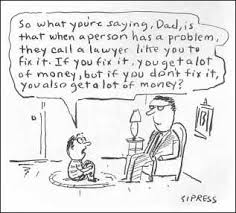
Just some humor to brighten your Friday.

Matthew Thompson is a Family Law attorney and reminds you to find the humor when and where you can…

img_6390

Tips for Witnesses.

Today’s advice is for potential witnesses.

images.jpg

#1 Don’t refuse to talk to the attorney if they call to talk to you, unless it’s smart to not to.

You don’t have to speak, but if you do you may can avoid a subpoena or having to testify later.

#2 Don’t try to refuse a subpoena.

It’s tacky. Refusing to touch the papers does not invalidate service.

#3 Don’t be rude.

I get you have a job, but so do I. I attempted to call you weeks ago and do this politely. You refused to answer or speak. You refused to call back.

#4 Don’t lie to get out of testifying.

It’s tacky too. And dishonest.

Matthew Thompson is a divorce attorney and just wants the facts.

img_6390


Do Not Answer a Question with “Sure.”

Testifying in Court can be hard. It causes stress, anxiety, and it is seldom a great experience. However, some responses should be eliminated from your vocabulary.

download.png

(adjective) surer, surest.

1.  free from doubt as to the reliability, character, action, etc., of something:

to be sure of one’s data.

2.  confident, as of something expected:

sure of success.

3.  convinced, fully persuaded, or positive:

to be sure of a person’s guilt.
(Slang definitions & phrases for sure)
Yes; certainlySure, I’ll support you (1842+)
While a slang use for sure could mean yes, it does not sound like it in Court.
NOT GOOD
Q: Mr. Witness, don’t you agree that telling your child that the other parent is a deceitful, hateful train-wreck is inappropriate.
A: Sure.
It sounds dismissive. It could be treated as a “whatever” response. You do not want to create an impression with the Court that you do not take the matter seriously.
BETTER 
Q: Mr. Witness, don’t you agree that telling your child that the other parent is a deceitful, hateful train-wreck is inappropriate.
A: Yes, I did. It was wrong. I regret it. I will not discuss grown up things with the child again. I’m sorry for that.
This response is not dismissive. It answers the question. It demonstrates remorse and that the conduct will not repeat itself.
BEST*
Q: Mr. Witness, don’t you agree that telling your child that the other parent is a deceitful, hateful train-wreck is inappropriate.
A: Yes, I agree that would be inappropriate, but I never did that, nor would I.
This response is the best. It answers the question directly and advises the Court you did not do the conduct being complained of. (This response is only possible if it is the truth.*)
Of course you can say the word sure and use it in other responses, but it should likely not be a one-word response.
Matthew Thompson is a Family Law attorney in Mississippi and is sure that you should not answer a question with “sure” most of the time.
img_6390

Witnesses, Facts and What you are Told.

You’re entitled to your own opinion, but you are not entitled to your own facts.

download.jpg

Testifying as a witness can be intimidating and scary. However, you do not have to let it get to you. Your job as a witness is to tell the truth, the whole truth and nothing but the truth. If you are testifying as a witness it is usually because you know something about the case and can help provide factual information. Your job as a witness, however is not to guess, speculate or even give your opinion, usually.

To be a good witness answer the question asked. Answer it with a “yes” or “no” or “I don’t know.” You may explain if you need to. Be direct. It is usually wise to only answer what is asked and it is also wise not to assume “facts” if you do NOT have personal knowledge of the underlying situation.

Also, someone telling you something does not make it a fact within your personal knowledge, even if they seem like they are telling the truth.

Matthew Thompson is a Family Law Attorney in Mississippi and reminds you to stick to the facts, just the facts.

img_6390

Hearsay, Hearsay, Read All About It.

Hearsay is any out of Court statement that is used to prove the truth of the matter asserted.
images

Hearsay is basically ANYTHING that is said outside of the Courtroom by ANYBODY.  It also includes writings, documents and many other things.

Most commonly hearsay occurs during witness testimony. Mom is testifying about how scared Beverly was when dad left her with the new and strange babysitter. However, mom did not see nor meet the babysitter. She didn’t even know she existed. Mom was trying to say that Beverly said the babysitter said “….”

Attorney: OBJECTION, HEARSAY.

Judge: SUSTAINED. DON”T TELL ME WHAT THE CHILD SAID OR WHAT THE BABYSITTER SAID.

The babysitter has to come testify or mom has to describe Beverly after dad’s weekend.

Mom:  She came home distressed and sullen. Her eyes were red, as if she’d been crying.

Beverly told her what happened, so she called dad. Now mom can say what dad said because he and she are the parties to the case, an exception to the hearsay rule.

Your attorney should practice your testimony and how to deal with hearsay.  You may always describe what you personally observed, what you did and what you said, and this is the way to possibly get around hearsay and/or having other witnesses involved testify.

Matthew Thompson is a family law attorney and encourages you to practice your testimony and telling your story without saying what somebody told you.

Follow the blog: BowTieLawyer 

You may also contact Matthew with your family law case, question or concern at (601) 850-8000 or Matthew@bowtielawyer.ms

Judges; Human Lie Detectors

“Do you swear or affirm the testimony you are about to give is the truth, the whole truth and nothing but the truth?”

All testimony is under oath. Judges apply the smell test to determine your truthfulness. Testimony that doesn’t make sense fails this test.

A man, after having been caught with his girlfriend, denied they were intimate because he could not…perform.  There was testimony that he had issues in that department. However, he was also on medication for his ailments.  He continued his medication even months after separating from his wife.  He did NOT have a good explanation for that.

Judge knew he was NOT telling the whole truth. You can lose your credibility on something seemingly trivial. Judges listen intently and judge you. That is their job. If you lie about little things or are “cute” with your answers then they may assume you’ll lie about big things.

Matthew Thompson is a Divorce Lawyer in Mississippi and recommends you tell the truth and nothing but the truth…but only answer what is asked.

Follow the blog: BowTieLawyer Visit the website: Thompson Law Firm

You may also contact Matthew with your family law case, question or concern at (601) 850-8000 or Matthew@bowtielawyer.ms.

black bow

Tip of the Day: Speak with Efficiency

ef·fi·cient
(especially of a system) achieving maximum productivity with minimum wasted effort or expense.
(of a person) working in a well-organized and competent way.
Sira Anamwong/ freedigitalphotos.net

Too often in Court, depositions, and generally responding to questions, witnesses provide too much information.  In an attempt to tell the “whole truth” the facts get muddled and the point gets lost.

I routinely ask client questions that can be answered simply, but rarely get the simple, straight forward response.

“How much child support are you Ordered to pay?”

“”$750.00 per month.”

“Have you paid it?”

“Well, you see, I was going to, but my car broke down and then I was writing the check ,but she said I could’t get them…”

There may be a great explanation, but first things first. Did you pay? Are you in compliance with the Order? Yes or No? Then explain if needed. Don’t try to guess. Just answer what is asked.

A great tip for doing this is to practice with your attorney so that you know why the question is being asked. Said another way, begin with the end in mind.

Matthew Thompson is a Family Law Attorney in Mississippi and wants you to tell your story, but answer the question first.

Follow the blog: BowTieLawyer Visit the website: Thompson Law Firm

You may also contact Matthew with your family law case, question or concern at (601) 850-8000 or Matthew@bowtielawyer.ms