Category Archives: General Legal

In Memoriam: Judge Tom Broome

Judge Tom Broome has passed away after a period of hospitalization.

Judge Broome, a long-time staple of the Rankin County Youth Court.

He touched many lives while serving as a Youth Court Judge and worked daily to have a fair and just judicial system. He surrounded himself with good people and genuinely had a servant’s heart.

Broome was a graduate of MC Law and was a part of one of the most distinguished graduating classes. His career added to the prestige.

Prayers and condolences for the family and colleagues.

Matthew Thompson is a family law practitioner and enjoyed practicing in Rankin Youth Court.

Equitable Maxims and Principles to Live By

Equity is about fairness, but does not require exact equality. All things being equal could very well not be fair or equitable. 22 maxims of Equity are below and while some are archaic or narrow in their application, many are relevant and applicable in today’s society and legal arenas.

1. One who seeks equity must do equity. This requires that if you are seeking relief of the Court you must have done all that was required of you by the Court Order.

2. Equity will not suffer a wrong to be without a remedy. This provides that the Court may grant relief even if there is not necessarily a clear remedy at law.

3. Equity regards as done what ought to be done. This holds that if you agree to do something then it is assumed you will have done it and done it well.

4. Equity is a sort of equality. Equity means fair, but does not = equality, hence “a sort of equality.” Think equal in opportunity, though there may not be equal outcomes.

5. Equity aids the vigilant, and not those who slumber on their rights. Equity requires you to act reasonably and diligently. You cannot wait an unreasonably long time to seek justice.

6. Equity imputes an intent to fulfill an obligation. An act consistent with a promise to act demonstrates an obligation and may well satisfy same.

7. Equity acts in personam. Equity is about the obligations of people, not objects.

8. Equity abhors a forfeiture. Fairness does not require a total loss even if you did not meet all obligations on time.

9. Equity does not require an idle gesture. Fairness does not require the Court to declare a hollow victory.

10. He who comes into equity must come with clean hands. Similar to #1, this requires that if you are seeking relief of the Court you must enter Court having not committed a violation.

11. Equity delights to do justice, and not by halves. If you are entitled to full restitution, then equity requires that you receive full restitution.

12. Equity will take jurisdiction to avoid a multiplicity of suits. Equity requires that all parties and all issues which could have been decided be decided and you are later prevented from seeking relief for the same issues.

13. Equity follows the law. An equitable result does not violate the law.

14. Equity will not assist a volunteer. This one needs explanation about a “volunteer.” In this instance it is not a do-gooder, instead it is one who received a benefit though they did not deserve it. Fairness does not require the “volunteer” be entitled to such benefit.

15. Equity will not complete an imperfect gift. A person that confers a benefit on a third party may not be relied upon if the first person did not have the right to do so in the first place.

16. Where equities are equal, the law will prevail. If both parties are equal in benefit/wrongdoing, equity does not apply.

17. Between equal equities the first in order of time shall prevail. If two persons have an equitable claim/right the person that had the claim/right first, wins.

18. Equity will not allow a statute to be used as a cloak for fraud. Fairness will not allow the presence or absence of a particular law be used for an unjust result.

19. Equity will not allow a trust to fail for want of a trustee. Merely because a Trustee is unable or unwilling to serve does not terminate a Trust.

20. Equity regards the beneficiary as the true owner. Again related to Trusts, while the Trustee may have the property or use there of, the beneficiary is the person entitled to the use or benefit thereof.

21. Equity will not allow a wrongdoer to profit by a wrong. Fairness does not provide the bad actor to win due to his bad actions.

22. Equity does not punish. Fairness restores one to where they should have been, it does not punish the wrongdoer.


Children Should NOT Pay for Adult Mistakes

We all mess up. It happens. However, when our mess up negatively affects others, merely fixing the mistake is not enough, especially when it’s a child.

Being an adult can be hard. Being a parent is hard. Being an adult that has to deal with children is hard. Making mistakes is inevitable. However, how those mistakes are dealt with is the difference between showing a true servant’s heart and being a cold, unapologetic robot.

As a parent, we have all messed up. A quick, heartfelt apology is always best. To the extent you can fix your mess up, you do it. When the correction causes more trauma, you don’t.

A child does not need to learn from an Adult’s mistake – even an honest mistake. That isn’t teaching the child a lesson. That’s actually showing adults are not accountable for their actions.

“My bad, but you suffer…”

Also, admitting your mistake is good. But the way its handled thereafter matters too. A heavy-hand is not always the best. Being respectful never goes out of style and attempts to deescalate problems is the #1 priority when dealing with these situations.

A wise man once said the referee could throw a flag on every play, wisdom is not doing so. Also, sometimes picking that flag up and waving it off is the right thing to do.

The lesson here is ultimately do the right thing. Protect the child, be honest, but don’t make that child suffer because of your mistake.

Also, it’s NEVER too late to do the right thing!

Matthew Thompson is a family law attorney in Mississippi and advises parents/adults to not make a child suffer because of your mistake.

TN Law Makes DUI Driver of Fatal Wreck Pay Child Support

Ethan’s, Hailey’s, and Bentley’s Law1 requires a sentencing court to order a defendant who has been convicted of vehicular homicide due to intoxication, and in which the victim of the offense was the parent of a minor child, to pay restitution in the form of child maintenance to each of the victim’s children until each child reaches 18 years of age and has graduated from high school.

Cecilia Williams , grandmother of, Bentley Williams, 5, and Mason Williams, 3, is raising her grandchildren after their parents were killed April 13, 2021, in a drunk-driving accident in Missouri.

Since her family members’ deaths, Williams has worked to get legislation called Bentley’s Law passed in Tennessee and several other states, including attempts in Missouri, that requires those convicted of driving while intoxicated to pay compensation to families affected by a drunk-driving death.

Tennessee Gov. Bill Lee signed the bill on May 25, 2022.

Along with Tennessee, Bentley’s Law has also been introduced in Missouri, Louisiana, Ohio, Pennsylvania, Virginia, Illinois, Alabama, South Carolina and Oklahoma. Vermont, Massachusetts, Hawaii, Kansas, Arkansas, Delaware, Wisconsin, Arizona, California, Colorado, Florida, Indiana, Michigan, Texas and Utah have stated plans to introduce similar laws during 2023 sessions.

David G. Thurby, 26, of Fenton, TN was charged and convicted of three counts of involuntary manslaughter in connection with the fatal accident in Byrnes Mill, Missouri.

After the fatal accident on April 13, 2021, Thurby was arrested and told a Missouri State Highway Patrol trooper that before the crash, he had seven shots of Crown and water, and a preliminary breath test showed Thurby’s blood-alcohol content was .192 percent, more than twice the legal limit, according to the probable-cause statement in the case.

A jury found Thurby guilty following a trial in front of Jefferson County Circuit Judge Victor Melenbrink.

In March, Judge Melenbrink sentenced Thurby to four years in prison on each of the three counts. Two of the counts are to be served consecutively with the other to be served concurrently, meaning Thurby is to serve eight years in prison.

Williams has set up a Facebook group called “Bentley’s Law” to share updates about the law’s progress in each state.

Matthew Thompson is Child Support lawyer in Mississippi and supports a law such as this in Mississippi.

  1. The law is named after children whose parents were killed in crashes caused by drunk drivers.

Mississippi Considers Irretrievable Breakdown…Again.

Mississippi considers legislation to make common sense changes to Family Law.

Pending before the Senate is an Act to amend MCA SECTION 93-5-1, to delete the requirement of “WILLFUL AND OBSTINATE” from the ground of desertion and to provide an additional ground when the “COURT FINDS THERE HAS BEEN AN IRRETRIEVABLE BREAKDOWN OF THE MARRIAGE AND THAT FURTHER ATTEMPTS AT RECONCILIATION ARE IMPRACTICAL OR FUTILE AND NOT IN THE BEST INTERESTS OF THE PARTIES OR FAMILY…”

This proposal is significant because it would allow for a divorce if the parties have been separated for over a year, regardless of the reason and additionally would allow the Court to divorce a couple if the Court was convinced the marriage was over and beyond repair, regardless if other fault grounds existed. These are just common sense changes.

These changes would bring Mississippi closer in line with 48 other states with regards to divorce. While still not a true no-fault provision, this allows for the possibility of relief in most cases when it was previously not. What do you mean by that, you ask? Financial/divorce blackmail is legal in Mississippi under its current law.

Mississippi does NOT have a no-fault divorce option. Either you have fault grounds or an agreement to all issues between you and your spouse and if you have neither of those, you cannot get a divorce in Mississippi.

These changes, or something similar, are kicked around every year. Last year a blue-ribbon panel assembled by the legislature recommended changes and it didn’t happen. These are much needed and will actually help serve and protect families in Mississippi.

Matthew Thompson is a Family Law attorney in Mississippi and supports these changes. (601) 850-8000

Don’t Lie to Your Attorney- or there will be Consequences…

This is not a threat. This is a fact.

Lawyers give their best advice based on what the client tells them. Based on what the “facts” are can significantly impact not only the outcome, but also the advice given.

Routinely, clients have denied certain conduct and based upon those assertion, advice is given. Then, the other side files a pleading alleging the very conduct. Many times I have called opposing counsel and asked that they provide the proof, as it may well change my advice.

When you lie to your lawyer it impacts your case. It impacts the advice given. It impacts the strategy of the case. It also impacts what your lawyer believes from you thereafter. AND, it can also impact the outcome of your case.

So, did you lie to your attorney about a material, critical part of your case? Did that lie effect the advice given and strategy used? Did that lie come back to bite you in the tail (and could have been minimized had you just told the truth)? So, think long and hard about lying to your attorney – – and don’t do it.

Matthew Thompson is a civil litigation attorney and knows the adage of if your lips are moving you’re lying, but still wants to believe the clients.

Marriage in Mississippi- Until Death…Irretrievable Breakdown is Dead.

A proposed bill died a quiet death in committee yesterday, the same committee that helped in the drafting and promoting it. This bill had previously passed the Senate as well…

In November, I wrote about the “word on the street” of changes coming in Family Law in Mississippi. Last summer the Mississippi Legislature assembled a blue-ribbon panel of lawyers, judges, legislators, law professors and the like to assess some of Mississippi’s more difficult or out-of-the-main-stream family law laws.

This panel suggested multiple changes with child support/age of majority and adding a 13th ground for divorce- irretrievable breakdown. This change would bring Mississippi in line with approximately 48 other states.

Part of the reason for the blue-ribbon panel was to gain insight from the practitioners, judges and persons dealing with the families this would impact. The rumor mill was that this was a done deal, was much-needed and would alleviate what one supreme court justice described as “financial blackmail.”

Yoggi Berra said it first, “It ain’t over ’til it’s over.”

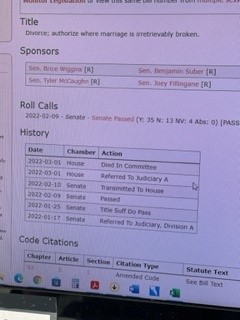
Senate Bill 2643 (Miss 2022) died in Committee on March 1, 2022, when it was referred to Judiciary A, by Speaker, Philip Gun.

“4   02/10 (S) Transmitted To House
   5   03/01 (H) Referred To Judiciary A
   6   03/01 (H) Died In Committee”

Unfortunately, we may never know all of the behind-the-scenes details on why this was studied, proposed, promoted, passed, referred and allowed to whither on the vine. But, it was a much needed change in Mississippi law and one that would do more to promote family harmony than anything else the Mississippi legislature could do.

This harkens back to 2017 when a legislator single-handedly killed attempts to add domestic violence as a specific element of a cruelty based divorce and allow for the victim’s testimony to be sufficient proof of such. Once the domestic violence provision was struck the firestorm that erupted caused an about-face of the legislator and the language reappeared in another bill…lets hope for some common sense and that history repeats itself.

Matthew Thompson is a Mississippi Divorce and Civil Defense Attorney and is routing for another Change of Heart!

Mississippi ID Goes Digital – MS Mobile ID

Forgot your wallet or purse? No problem. You now have a legal, state issued ID on your phone or mobile device….and, we know you did not forget your phone!

MS Mobile ID https://www.driverservicebureau.dps.ms.gov/mobile-id/

Mobile ID is an app allowing Mississippi residents to maintain a valid, state-issued ID on their device. Mobile ID reports that it is a “highly secure, digitized version of your driver license or state-issued ID, carried in an app on your smartphone”

Mobile ID is endorsed by the Department of Public Safety and the MS Drivers Service Bureau. “Mississippi Mobile ID keeps user data secure and ensures privacy of personal information by only storing information with the state system of record and on the user’s device.”

Mobile ID offers a contactless method for verifying identity. “Mobile ID allows the DPS to push updates to information such as an address change or status update, so verifiers can be confident the identity they are accepting is authentic and up-to-date.”

This appears to be safe, easy and legitimate. Now you can have your ID on you whether you have your wallet or not.