The Noncustodial Parents’ Bill of Rights and Responsibilities which shall be provided to all noncustodial parents.
The Department of Human Services shall extend the following rights to noncustodial parents:
(a) Advance notification of all hearings concerning proposed modifications of child support;
(b) Advance notification concerning the representation of the noncustodial parent in court proceedings, which does not require an attorney;
(c) That the noncustodial parent shall have the same rights as the custodial parent concerning the receipt of any notification;
(d) Advance notice of information regarding scheduled meetings concerning the child;
(e) Advance notice of all meetings concerning all the agency’s crucial decisions regarding the child; and
(f) The ability to communicate with department personnel or representatives twenty-four (24) hours a day, seven (7) days a week, for the purpose of aiding the noncustodial parent.
This is not a sea-change, nor profound. The non-custodial parent is already entitle to notice, the right to counsel, the right to information, notice of meetings and decisions. The last item, the ability to communicate 24/7 seems unreasonable, but maybe that just means you can leave a message or send an email. Who knows?
Non-custodial parents already have rights! **Of note, there has yet to pass a Parent’s Bill of Rights in Mississippi law** However, even without that, parent’s have a fundamental right, guaranteed by the US Constitution to raise their child as they see fit.
Matthew Thompson is custody attorney in Mississippi and has represented hundreds of moms and dads in family courts throughout the state.
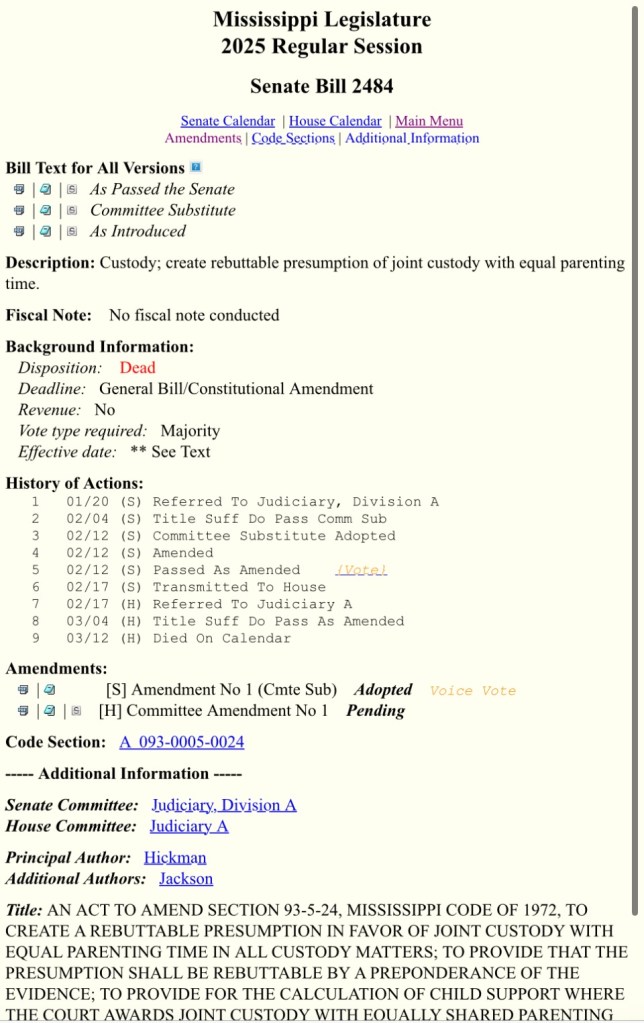
Senate Bill 2484, seeking to create a presumption of joint custody died yesterday, March 12.
This Bill which passed the Senate initially, then amended in the House, passed and sent back was ultimately not voted on and died a calendar death on 3/12/25.
It sought to require Joint Physical Custody and equal parenting time in every custody case unless the Court found a compelling reason to not grant shared parenting.
It necessarily would have put the every other weekend schedule as “standard” as outdated…
It also sought to amend child support determinations in the event joint custody was granted.
But, alas, it’s for naught. The scuttlebutt was there was an upswell of concerns about how far this proposal really went and that judges and even some family law attorneys had concerns.
Regardless, there will be no significant changes in family law this session…
Matthew Thompson is a child custody and child welfare attorney in Mississippi.
Courts usually grant custody to one parent or the other and the non-custodial parent exercises his time at places and locations he sees fit…
However, sometimes the Court needs an unusual solution to an unusual problem.
Consider the Birds Nest custody arrangement.
In a birds nest, the children stay in the “nest” aka the marital home and mom and dad take turns coming and going from the home.
During mom’s time she has custody to the children and the home, to the exclusion of dad.
During dad’s time he has exclusive custody of the kids and home and mom is excluded.
This is a good solution when the child has a unique need and having that structure of home base is in their best interest.
It’s also a viable solution when use of the home is needed by a party for work as the “home office” or tools of the trade are kept on the property.
This is not an often used remedy as it requires potentially 3 temporary residences, but can be an effective tool in the tool belt of solutions in limited circumstances.
Matthew Thompson is a child custody attorney and recommends the birds nest in unique cases.
Mississippi Courts have not historically favored Joint Custody. A new Bill would require a presumption of Joint Custody is best for a child, that would have to be overcome if a parent doesn’t agree…
Senate Bill 2484 seeks to amend the current custody statute 93-5-24, as follows: “
(2) * * * (a) (i) There shall be a rebuttable presumption that joint custody and equally shared parenting time is in the best interest of the child. If the court does not grant joint custody and/or equally shared parenting time, the court shall construct a parenting time schedule which maximizes the time each parent has with the child and ensures the best interest of the child is met. (ii) The presumption created in subparagraph (i) of this paragraph shall be rebuttable by a preponderance of the evidence. A court that does not award joint custody with equally shared parenting time shall document the reasons for deviating from the presumption. (b) Upon petition of both parents, the court may grant legal and/or physical custody to one (1) parent.”
This is an interesting Bill and in theory how Custody determinations should begin anyway. However, it goes further than current law in creating a rebuttable presumption and then requiring documenting the reasons for deviating from the presumption if the court does not grant joint physical custody and/or equally shared parenting time.
Matthew Thompson is a child custody lawyer and believes mom and dad coparenting and working together is what’s best for the child. A set schedule based on the child, with flexibility when warranted is what is best…
A child testifying is an often discussed issue between parents and attorneys in child custody cases.
When parents are getting a divorce the child usually knows more than their parents think. The child most likely witnessed fights, bad conduct and sometimes even dangerous conduct.
In Mississippi law, the leading authority is Jethrow vs. Jethrow, 571 So.2d 270 (Miss. 1990). This case lays the groundwork that the Court should use when assessing child testimony. The basic premise is, as follows;
A child witnesses of tender years*, 12 and under for testimony purposes, testifying is subject to the discretion of the Judge. (*this tender years is different than the “tender years” doctrine favoring a mother when a child is very young, under 2-3).
Before allowing such testimony the Judge “should satisfy himself that the child has the ability to perceive and remember events, to understand and answer questions intelligently, and to comprehend and accept the importance of truthfulness.”
Before excluding the testimony of a child witness of tender years in a divorce proceeding, the chancellor at a minimum should follow the procedure required by Crownover v. Crownover, 33 Ill.App.3rd 327, 337 N.E.2d 56 (1975):
The first hurdle is whether the child is competent to testify.
The Judge should confer in camera (meaning in the Judge’s chambers/office) with the child and determine whether or not the child’s testimony should be heard
The Judge has considerable discretion in conducting proceedings of this type, meaning it’s a judgment call.
The court should not, however, reject outright proposed testimony of a child in custody proceedings, where the omission of such crucial testimony might be harmful to the child’s best interests.
The trial court should take great pains to have an in camera conference with the child to determine the competency of the child,
and determine the competency of any evidence which the child might present.
The court should determine whether the best interests of the child would be served by permitting her to testify, or
Whether the child should be sheltered from testifying and being subjected to a vigorous cross-examination.
The Judge should report the essential material matters developed at the in camera conference on the record.
The Court should state the reasons for allowing or disallowing the testimony of the child, and
The Court should note the factual information which the court developed from the conference with the child which would be considered by the court in its ultimate determinations in the case.
Generally, the testimony of a child called as a witness in a divorce case should not be excluded for reasons other than competency, or evidentiary defects, or for the protection of the child. (24 Am.Jur.2d, Divorce and Separation, A 415). There should not be a summary refusal to inquire as to the competency of the child to testify and also of the competency of the proposed testimony of such child in a change of custody proceeding.
“We reiterate that parents in a divorce proceeding should if at all possible refrain from calling any of the children of their marriage, of tender years at least, as witnesses, and counsel should advise their clients against doing so except in the most exigent cases. The reason and wisdom behind this precaution need no amplification. We also hold, however, as we must that no parent can be precluded from having a child of the marriage in a divorce proceeding testify simply because of that fact.”Jethrow v. Jethrow, 571 So.2d 270, 274 (Miss. 1990)(emphasis added).
A child testifying should be avoided, however if it cannot be avoided the above process will likely be used by the Court to determine if and how the child will testify.
Matthew Thompson is a Child Custody Litigation Attorney in Mississippi.
Thirteenth. Upon application of either party, the court may grant a divorce when the court finds there has been an irretrievable breakdown of the marriage and that further attempts at reconciliation are impractical or futile and not in the best interests of the parties or family.
Secondly, a Joint Custody bill was proposed. There were several iterations of this legislation, but the gist of it was that the Court was to assume that Joint Physical Custody was in the best interest of the child when parents could not agree (and, even if they could) and if the Court found Joint Physical Custody was not in the best interest of the child it had to state why. (There were some issues with the proposed legislation as it was drafted, but this Bill found some traction and was discussed and bandied about for weeks…ultimately to no avail).
(2) * * * (a) There shall be a presumption, rebuttable by a preponderance of evidence, that joint custody and equally shared parenting time is in the best interest of the child. If the court does not grant joint custody and/or equally shared parenting time, the court shall construct a parenting time schedule which maximizes the time each parent has with the child and ensuring the best interest of the child is met. (b) Upon petition of both parents, the court may grant legal and/or physical custody to one parent.
Both bills failed and there are limited changes to MS Family Law. A blog for another day.
Matthew Thompson is a Family Law Attorney in MS and is in favor of some common sense changes in Mississippi Law.







 (601) 850-8000 - - BowTieLawyer.MS