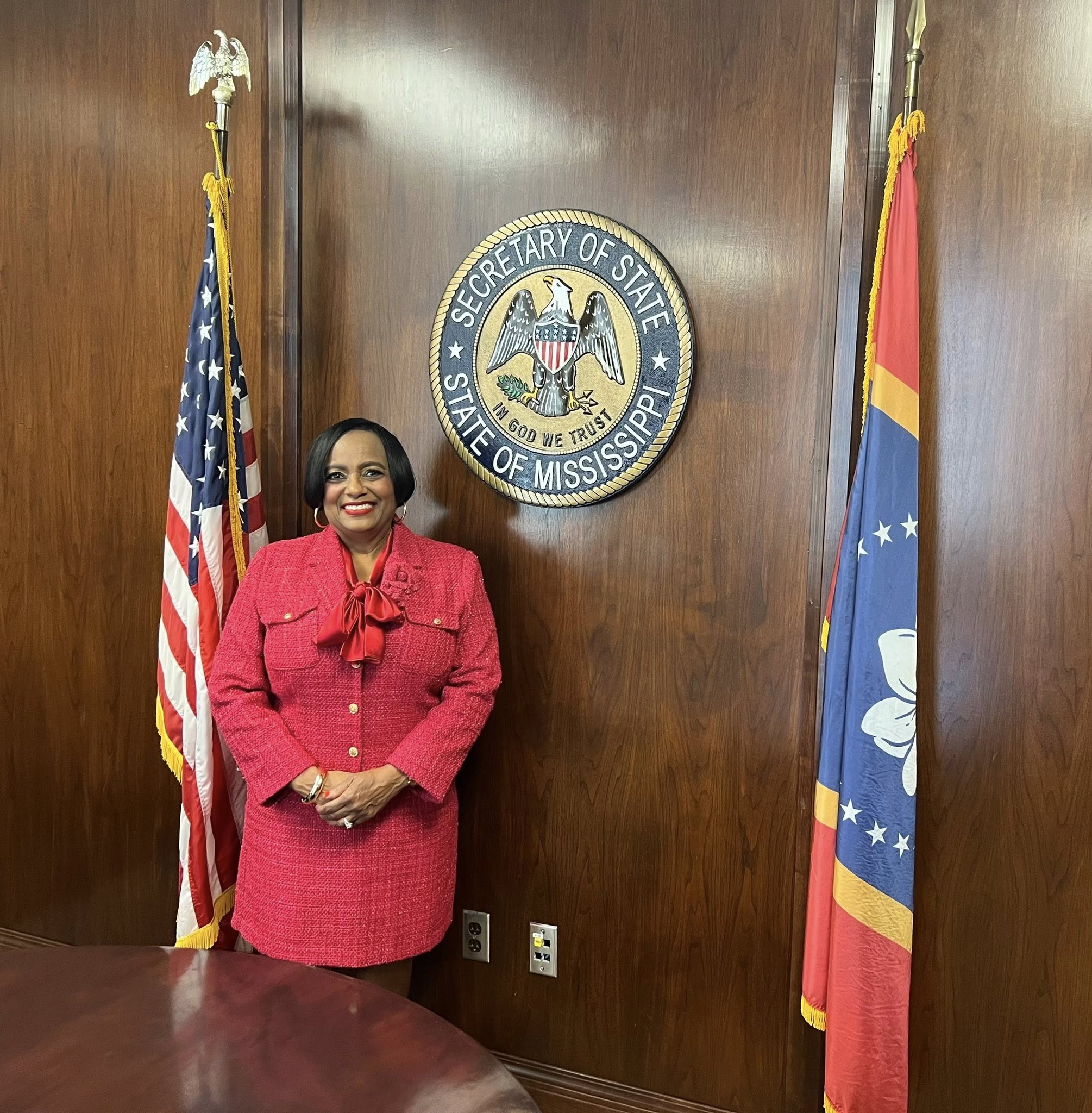
Hinds County Attorney, Bridgett Clayton, has qualified to run for Hinds County Chancery Judge!
“After much prayer and consideration, I am honored and excited to announce that I qualified for Hinds County Chancery Court Judge, District 5-3, on today.”
“I am ready to serve the citizens of Hinds County with God serving as a Lamp unto my feet and the Light unto my path as I seek election for this judicial seat to do justly, love mercy, and walk humbly before my God. Micah 6:8”
I am requesting your prayers and support during the campaign as well as on Election Day which is November 3.
Please be on the lookout for future campaign information. Thank You!
Matthew Thompson is a Chancery practitioner and knows-well the power, authority and responsibility that Chancellor’s have and the knowledge and wisdom they should possess. Attorney Bridgett Clayton has all of those qualities and then-some!
Please support Bridgett Clayton for Hinds County Chancellor!
Senate Bill 2029, ( Sen. Brice Wiggins) proposes some common-sense change to Mississippi Family Law…for the umpteenth time in the last 20 years.
This Legislation proposes to add a 13th ground.
“Thirteenth. Upon application of either party, the court may grant a divorce when the court finds there has been an irretrievable breakdown of the marriage and that further attempts at reconciliation are impractical or futile and not in the best interests of the parties or family.“
This change would bring Mississippi in-line with 48 other states and Puerto Rico, all having true No-Fault divorce laws.
The other piece of this legislation eliminates the willful and obstinate aspects for abandonment and only requires “Continued * * * desertion for the space of one (1) year.”
These are common-sense changes in MS family law and would actually prevent protracted litigation and messy, expensive contests.
Matthew Thompson is a family law attorney and reminds you this Bill is contrary to the divorce attorney’s best interests and I am in support of these changes!
A child testifying is an often discussed issue between parents and attorneys in child custody cases.
When parents are getting a divorce the child usually knows more than their parents think. The child most likely witnessed fights, bad conduct and sometimes even dangerous conduct.
In Mississippi law, the leading authority is Jethrow vs. Jethrow, 571 So.2d 270 (Miss. 1990). This case lays the groundwork that the Court should use when assessing child testimony. The basic premise is, as follows;
A child witnesses of tender years*, 12 and under for testimony purposes, testifying is subject to the discretion of the Judge. (*this tender years is different than the “tender years” doctrine favoring a mother when a child is very young, under 2-3).
Before allowing such testimony the Judge “should satisfy himself that the child has the ability to perceive and remember events, to understand and answer questions intelligently, and to comprehend and accept the importance of truthfulness.”
Before excluding the testimony of a child witness of tender years in a divorce proceeding, the chancellor at a minimum should follow the procedure required by Crownover v. Crownover, 33 Ill.App.3rd 327, 337 N.E.2d 56 (1975):
The first hurdle is whether the child is competent to testify.
The Judge should confer in camera (meaning in the Judge’s chambers/office) with the child and determine whether or not the child’s testimony should be heard
The Judge has considerable discretion in conducting proceedings of this type, meaning it’s a judgment call.
The court should not, however, reject outright proposed testimony of a child in custody proceedings, where the omission of such crucial testimony might be harmful to the child’s best interests.
The trial court should take great pains to have an in camera conference with the child to determine the competency of the child,
and determine the competency of any evidence which the child might present.
The court should determine whether the best interests of the child would be served by permitting her to testify, or
Whether the child should be sheltered from testifying and being subjected to a vigorous cross-examination.
The Judge should report the essential material matters developed at the in camera conference on the record.
The Court should state the reasons for allowing or disallowing the testimony of the child, and
The Court should note the factual information which the court developed from the conference with the child which would be considered by the court in its ultimate determinations in the case.
Generally, the testimony of a child called as a witness in a divorce case should not be excluded for reasons other than competency, or evidentiary defects, or for the protection of the child. (24 Am.Jur.2d, Divorce and Separation, A 415). There should not be a summary refusal to inquire as to the competency of the child to testify and also of the competency of the proposed testimony of such child in a change of custody proceeding.
“We reiterate that parents in a divorce proceeding should if at all possible refrain from calling any of the children of their marriage, of tender years at least, as witnesses, and counsel should advise their clients against doing so except in the most exigent cases. The reason and wisdom behind this precaution need no amplification. We also hold, however, as we must that no parent can be precluded from having a child of the marriage in a divorce proceeding testify simply because of that fact.”Jethrow v. Jethrow, 571 So.2d 270, 274 (Miss. 1990)(emphasis added).
A child testifying should be avoided, however if it cannot be avoided the above process will likely be used by the Court to determine if and how the child will testify.
Matthew Thompson is a Child Custody Litigation Attorney in Mississippi.
I recently read the book Flim Flam. One theme that stuck out was that your activities through electronic devices leaves a footprint that can be traced back to you.
This is a good lesson for persons maneuvering a family law matter. Your digital footprint will lead back to you.
I am regularly asked how many cases have I won? Potential clients, non-lawyers, friends and relatives use this terminology. But, winning a case isn’t really about winning. It’s about mitigating damages and liability. It’s about preserving finances and relationships, if possible. A win is really knowing the best and worst case scenario and achieving what you aimed for or better.
When is a win not a win? When you leave a wake of havoc, of hate and a trail of tears.
Unfortunately, some lawyers take this tactic in Family Law. They believe scorched earth is the best and only approach. What they do not tell their clients, though, is that it is really only what is best for themselves, the lawyer. It is best for the lawyer financially, or perhaps they even have a personal animus against the other party or the the other lawyer.
Lawyers, in my experience, do not like to give the tough advice. That the fight is not worth it emotionally or financially. That if you win the other side ends up hating you and will spend the rest of their days waiting for you to mess up so they can pounce upon you.
The win at all costs approach results in frivolous filings, extreme delay, and angry judges. The overwhelming “win” results in an appeal, bar complaints and ultimately you may well lose in the end.
A Win is really not being unpleasantly surprised in the end result. A win equates with maintaining your relationships with your children and immediate family and having the means to provide a satisfactory life.
Matthew Thompson is a Divorce attorney and advises his clients when a win is a win and when it is not.
Follow the blog: #BowTieLawyerVisit the website: #Thompson Law Firm. You may also contact Matthew with your family law case, question or concern at (601) 850-8000 or Matthew@bowtielawyer.ms
If you or I answered questions in Court like any politician we might be held in contempt.
vectorolie/ free digitalphotos.net
In Court, witnesses must answer the question asked. Usually the answer will be “yes” or “no,” and then an explanation may be offered if necessary. This can be very difficult to do and it takes practice to get this right.
Not answering the question with a “yes” or “no,” and not answering what was asked may result in the Court concluding you are being deceptive. This is not an impression you want to create.
As a witness, however, you only want to answer the question asked. Do not answer what is not asked and do not offer more than what is asked. The best example I can think of is when a party was asked if they had committed an affair with “Mary” since the separation.
The answer, “I have not committed an affair with ‘Mary’…since the separation.” There was an awkward pause. The awkward pause resulted in the follow-up question of when did you commit your affair with Mary. The party told on himself by not just saying “No” which would have been a completely truthful answer to the question asked.
Matthew Thompson is a Family Law attorney and warns witnesses to answer “yes” or “no,” explain if necessary, and sometimes less is more.
Follow the blog:#BowTieLawyer Visit the website: #Thompson Law. You may contact Matthew with your family law matter or question at (601) 850-8000 or Matthew@bowtielawyer.ms
“We’ll just let the Judge decide!” famous last words…
m_bartosch/ freedigitalphotos.net
Court can take a while for a myriad of reasons.
From filing and just getting a Court date, which could be 3 months to 13 months in the future, to finding and serving the Defendant with proper process, can take longer than expected.
A mistake in not attaching the correct summons, having the incorrect date or time or not properly signing the papers can all lead to delay.
The Judge’s schedule can cause delay. The trial from yesterday may bump you. An Emergency in another matter will bump you. A Commitment, Domestic Violence matter or even one that will be “real quick” can bump you.
Slow witnesses, attorneys that ask a lot of questions, even pointless questions cause delay. Unavailable experts, extra long lunch breaks and multiple recesses add to the length.
Injuries, illnesses and hospital visits delay trials. Also, if you don’t finish in the time allotted, don’t assume you will bump tomorrow’s trial, because you might not!
Not to mention CONTINUANCES.
Even when the trial is over your case may not be. The Court has up to 6 months to Rule on your matter.
Court can take longer than it should and once you find yourself in contested litigation you may well not have a choice but to go along for the ride.
Matthew Thompson is a Family Law Attorney in Mississippi and knows that the Wheels of Justice Can Turn Slow.
Follow the blog: #BowTieLawyer Visit the website: #Thompson Law Firm You may also contact Matthew with your family law matter or question at (601) 850-8000 or Matthew@bowtielawyer.ms
It happens to the best of us. “We” get excited, animated and emotional, but you need to try to keep that in check. Lawyers are guilty of this too!
Here’s the set-up. The Divorce Agreement provides that either “party shall receive advance notice of any out of state travel, overnight, with the minor child by the other parent.“
Not an unreasonable clause. It does not require permission, but notice.
So, one parent, on multiple occasions does not give the other parent notice. The unknowing parent finds out about the timing of the trips during their time with the child, after the trips have occurred.
What’s the harm you ask? Well, these parents live 2-states away from one another. Where was the undisclosed trip? Yes, the other parent’s home state, just a few hours away. A great opportunity for a visit! But, alas it did not happen.
Upon questioning the parent defended not telling the other because the second parent did not ask. Here’s where the yelling comes in.
“HOW DOES THE OTHER PARENT KNOW TO ASK ABOUT THE TRIP IF YOU DON’T TELL THEM ABOUT THE TRIP ?!?“








 (601) 850-8000 - - BowTieLawyer.MS