Tag Archives: irreconcilable differences

BlackMail is Legal in Divorce – The Law in Mississippi; Promoting Fights Since 1976

Mississippi law provides for parties to gain a divorce through one of two methods; 1) Agree to the Divorce and all issues, called an Irreconcilable Differences Divorce, or 2) pursue a Fault Based Divorce granted due to the other party’s misconduct. That’s it. Mississippi does not have a true NO FAULT divorce process.

So,what happens if you cannot agree and do not have grounds?

Divorce Blackmail

In the mid 1980’s this issue was pointed out by the Mississippi Supreme Court.

       “Prior to 1976 mature and responsible people who found their marriages irretrievably broken were offered by our law absurd choices…the complaining spouse had to choose between outright perjury and hoping that the chancellor would not strictly enforce the standards of proof legally required to establish one of the twelve grounds for divorce. The other choice…the ‘knock down, drag out’ fight to which the adversary system invariably leads…frequently creating more problems than are solved. Divorce had become a degrading, dehumanizing experience.”

Gallaspy v. Gallaspy, 459 So.2d 283 (MS 1984). Justice James Robertson, Concurring Opinion

       …further improvements in our law are needed. As enlightened and desirable as was the enactment of the Irreconcilable Differences Act in 1976, the job has not yet been completed…[the] Irreconcilable Differences Act–it facilitates, even encourages, financial blackmail…the chancery court has not authority to grant a divorce…unless the parties have reached an agreement…the spouse wanting the divorce or feeling that he or she must obtain a divorce is subject to financial blackmailA party without fault grounds and no mutual agreement has only two options; (1) knuckle under and accept less than favorable financial terms or (2) go to court and try to obtain a contested divorce and an accompanying alimony and support award, when, as she and her lawyers surely must have known, she really did not have “grounds.” Id.

Justice Robertson actually proposed adding a 13th fault ground of Irreconcilable Differences, which if proven would allow the Court to award an ID divorce to one party, even over the objection of the other party and would allow the Court to rule upon the support issues.

However, Mississippi law actually perpetuates Blackmail.  If your spouse won’t agree and you don’t have fault grounds then you are STUCK.

There have been a number of bills proposed to end this divorce conundrum, but so far none has gained any traction.  Let me know your thoughts.  Do you support allowing for a true No Fault divorce, or an irreconcilable differences divorce after a period of separation?

Matthew Thompson is a Family Law attorney and is in favor of amending the Irreconcilable Differences divorce statute.

Follow the blog: BowTieLawyer 

img_6390

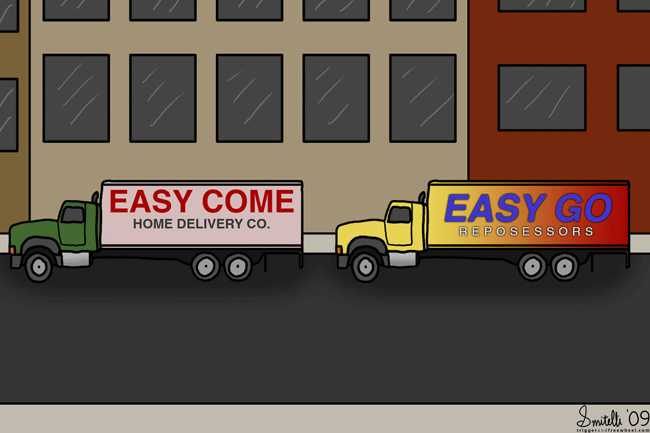
Easy to Get Married; Hard to Get Divorced.

“Easy Come, Easy Go” does NOT apply to Family Law.

http://www.triggerandfreewheel.com/comic/easy-come-easy-go

It’s easy to get Married. Quick, too.  Just show:

  1. Both parties must apply together
  2. Both parties must present a valid I.D. (Driver’s License, Birth Certificate, Military I.D., DD214, Baptismal Certificate, Life Insurance Record, School Record, or any other official document evidencing age. The Clerk shall retain a copy on file.
  3. $23.00 CASH fee (or similar fee depending on County)
  4. If either party has been divorced within the last six (6) months, a copy of the divorce decree is required

Additional Information

  1. If either applicant is under TWENTY-ONE (21) years of age, parental consent is required
  2. The female applicant must be at least fifteen (15) years of age to apply
  3. The male applicant must be at least seventeen (17) years of age to apply
  4. The license may be used only in the State of Mississippi

Harrison County Circuit Clerk.

It can be very difficult to get a Divorce.

You and your spouse must;

  • Agree to a Divorce
  • Agree to all of the Terms of the Divorce Agreement (including custody, support, visitation, property division and financial terms)

The basic process is;

  • File a Joint Complaint for Divorce (this begins a 60 day waiting period)
  • Prepare and exchange financial Statements
  • Prepare and sign the Child Custody and Property Settlement Agreement
  • Prepare and sign the Final Judgment of Divorce
  • Present the paperwork to the Court for approval (after 60 days of the initial filing)
  • Possibly attend Parenting Class

This ONLY works if you and your spouse can AGREE To EVERYTHING.  If you cannot then you must pursue a Fault based divorce.

Fault requires:

  • File a fault-based Complaint for Divorce (determine if you need Temporary Relief)
  • Have a Summons issued (Rule 4, 81 or both)
  • Have your spouse served with the documents
  • Prepare and attend a Temp. Hearing
  • Propound Discovery
  • Issue subpoenas
  • Respond to Discovery
  • Take Depositions
  • Have a Contempt hearing
  • Prepare and exchange financial Statements
  • Possibly attend Parenting Class
  • Set Trial
  • Prepare for trial (6-12 months from now)
  • Trial gets continued for some reason
  • Attend Trial
  • Await Ruling
  • Be aggrieved
  • Both parties file Appeals
  • 1 1/2 years later get ruling on appeal
  • Matter is Remanded
  • Repeat the above

“… it is the greatest of all mistakes to begin life with the expectation that it is going to be easy, or with the wish to have it so.”
Lucy Larcom

Follow the blog: BowTieLawyer Visit the website: Thompson Law Firm

You may also contact Matthew with your family law case, question or concern at (601) 850-8000 or Matthew@bowtielawyer.ms.

black bow

Common Divorce Vocabulary- 8 Terms to Know

Lawyers have their own language. It’s a mishmash of legal jargon, Latin phrases, arcane vocabulary words and .50 cent words to make us sound smart.  Here are just a few of the common terms.

Final Judgment of Divorce, or Final Judgment or Decree of Divorce or Final Order of Divorce.

This is the technical divorce.  This is the document that once signed by the Judge and filed by the clerk means you are divorced.  Every single case will have this document.

Property Settlement Agreement, PSA, Marital Dissolution Agreement, MDA, Final Separation Agreement, etc.

These are your “divorce papers.”  This recounts your rights, obligations, and the terms of your divorce. If your divorce ended via an Agreement you will have one of these.

Opinion of the Court.

These are your “divorce papers” if the Judge decided your case.  If you did not agree, but went to Court and the Judge ruled you will have, most likely an Opinion and Final Judgment.

Qualified Domestic Relations Order

This is how divisible retirement accounts are divided and apportioned to each party without tax consequences.  Commonly referred to as a QDRO (pronounced quah-drow) .  Depending on what you do with the funds after the QDRO transfer ultimately determines if there are taxes, what amount and penalties, if any.

No Fault Divorce.

It’s not technically “No Fault” in Mississippi, but rather Irreconcilable Differences or (ID).  This requires the parties to agree to the divorce and all the terms, which include custody, support, alimony and division of the property both real and personal.  This would be detailed in the Property Settlement Agreement.

Fault Divorce.

A divorce granted on fault grounds; adultery, cruelty, drunkenness, drug use, etc.

Real Property.

The house(s) and land.

Personal Property.

The stuff; cars, couches, TVs and spoons.

Child Custody

A determination of both legal and physical child custody.  Sometimes referred to as primary or joint or sole or paramount.  Each possibly meaning something different and then Visitation thrown in for good measure.

Matthew Thompson is a Mississippi based Family Law Attorney and Adjunct Professor of Domestic Relations.  Knowledge is Power, the more you know…

Follow the blog: #BowTieLawyer 

img_6390

Lose Over 180 lbs in Just 60 Days* (via Divorce)

Lose weight fast. This is not the type of “diet” usually recommended by Doctors, but it can free you from an unhealthy situation.

Mississippi law provides for an Irreconcilable Differences divorce process that can streamline divorce.  An “ID” divorce is the quickest, cheapest and most amicable means to get a divorce.  However, it is not always possible to take advantage of this type of divorce.

You and your spouse must;

  • Agree to a Divorce
  • Agree to all of the Terms of the Divorce Agreement (including custody, support, visitation, property division and financial terms)

The basic process is;

  • File a Joint Complaint for Divorce (this begins a 60 day waiting period)
  • Prepare and exchange financial Statements
  • Prepare and sign the Child Custody and Property Settlement Agreement
  • Prepare and sign the Final Judgment of Divorce
  • Present the paperwork to the Court for approval (after 60 days of the initial filing)

So, if you need to lose weight fast in the form of your spouse, please consult an attorney and consider the “ID” diet.

Matthew Thompson is a divorce attorney and can help you lose weight fast, via divorce.

Follow the blog: BowTieLawyer Visit the websiteThompson Law FirmYou may also contact Matthew with your family law case, question or concern at (601) 850-8000 or Matthew@bowtielawyer.ms

img_3045-1

Divorce, Two Ways

In Mississippi it can be very difficult to be awarded a divorce.  There are basically two ways to get a divorce.

download

The most common way is Irreconcilable Differences.  This is what is referred to as “no fault.”  However, MS is NOT a true no fault state, so in order to get a divorce on Irreconcilable Differences both parties have to agree to the divorce AND all the terms of the divorce, including; custody, visitation, support, alimony, division of the assets and debts.  If there is no agreement to all of the issues there may not be a divorce.

The other way to get a divorce in MS is based upon Fault Grounds.  In order to get a divorce on Fault Grounds you have to sue based upon fault grounds and prove your case.  Most commonly fault includes; adultery, cruelty, drug use, drunkenness, and abandonment.  There are a few other Fault Grounds, but are rarely used; incest, bigamy, insanity, etc.

It can be a frustrating circumstance when you and the other party cannot agree to all issues and neither party has grounds.  You may be stuck.  In this instance one party may resort to divorce blackmail, which is alive and well in MS.

Matthew Thompson is a Family Law attorney and cautions that divorce 2-ways can be caused by 3-ways.

Follow the blog & Visit the website:: BowTieLawyer  Thompson Law Firm

You may also contact Matthew with your family law case, question or concern at (601) 850-8000 or Matthew@bowtielawyer.ms

black-bow

From No Fault to Yo’ Fault

The clever title to this blog was proposed by an attorney friend of mine that handles some family law matters, but practices extensively in other areas of law.

We were recently discussing how “No Fault” cases get derailed.  While Mississippi is technically not a true “No Fault” state, there are provisions for an Irreconcilable Differences divorce.  (commonly referred to as “No Fault,” blogged prior.)

We were discussing what gets them off track.  The parties, after getting over the initial shock of divorce, decide they will be adults and agree.  They think they can agree to the divorce and resolve their differences.   After all, they did manage to get along for 9 years, have two kids and bought a house.  What could go wrong?   Perhaps they searched online and looked at divorceyourself.com.  A very risky idea!

Well, the old adage that the devil is in the details is never truer than in divorce.  The No Fault idea gets derailed when the fellow realizes he will have to pay 20% of his income towards child support, plus health insurance and alimony. Yikes!  He realizes it’s cheaper to keep her.  (sorry for the cliché)  The wife gets squirrely when she realizes that her half of the retirement account is consumed by balancing the equity in the house, or that the money she gets cannot be realized without significant tax consequences.

Parties to a divorce don’t realize child support is until 21, not 18 in Mississippi.  They don’t know the types of custody, or what that means.  They agree to things that they cannot legally agree  to and fail to consider the consequences.  They agree to “legal terms” that do not exist in Mississippi law, because they saw it online.  And lastly, one of them is finally convinced to see an attorney by a close friend or family member and when they do and realize the consequences of what they were about to do and back out, the other side becomes angry and backs out too.  All of a sudden an easy deal becomes complicated, expensive and adversarial.

Want to keep your situation from going from No Fault to Yo’ Fault?  Do your homework, have an assessment with an attorney that practices family law, keep the peace, and be smart.

Matthew Thompson is a family law attorney that can handle your divorce whether it’s your fault, their fault, or somebody else’s.  Trust the Bow Tie.

Follow the blog: BowTieLawyer

 img_6390

What to do when your Differences Cannot be Reconciled?

Irreconcilable Differences (“ID divorce”) is Mississippi’s answer to the NO FAULT* divorce.  Mississippi is not a true NO FAULT state. In MS both parties must agree to the divorce and to all the terms of the divorce, including ALL issues of child custody, child support, equitable distribution (how MS divides your stuff) and alimony, if any.  Every issue has to be agreed upon to gain an ID divorce***.  If ALL can be agreed upon, an ID divorce is just about the quickest and least expensive way to get a divorce in MS.

The basic process is;

1) File a Joint Complaint for Divorce (begins the 60 day waiting period**),

2) Exchange Financial Statements (called an 8.05),

3) Draft and sign an Agreement stating all of the details of who gets what, and who pays what (called a Property Settlement Agreement or PSA),

4) Draft and sign a Final Judgment (the actual divorce), and finally

5) Present all to the Judge for approval.

The Judge will review the Filings, Financial Statements and Agreement, and if the judge finds it “adequate and sufficient” will sign off.   Upon the signed Final Judgment being filed and recorded by the clerk- You are DIVORCED.

Well that is fine, but what if we thought we could agree and now we cannot? What can I do then?

Either party can prevent an ID divorce by;

1) Not agreeing;

2) Not signing anything;

3) Filing on Fault;

4) Filing a Notice of Withdrawal of Consent.

An ID divorce is the most often granted type of divorce in Mississippi and even most fault based divorces are converted into an ID divorce.  The benefit to an ID divorce is that it does not require adversarial positions to be taken in Court and it gives you, the parties, the ability to agree and have the say in the outcome of your situation.  Anything that could be had in a fault based divorce can likewise be achieved in an ID divorce, with the sole exception of having the divorce granted on fault.

* In a NO FAULT state either party can secure the divorce regardless if the other party agrees . In the event they cannot agree the Court can divide the property.

** The 60 day waiting period is the minimum time that the parties to an ID divorce must wait. It is designed as a cooling off period.

*** There is also the possibility of a hybrid situation where you and your spouse can agree on the divorce and agree to let the Judge decide the issues that you cannot agree upon.  This technique, however, has its risks and should not be gone into lightly and certainly not without consultation of an attorney.

You may also contact Matthew with your family law case, question or concern at (601) 850-8000

black-bow