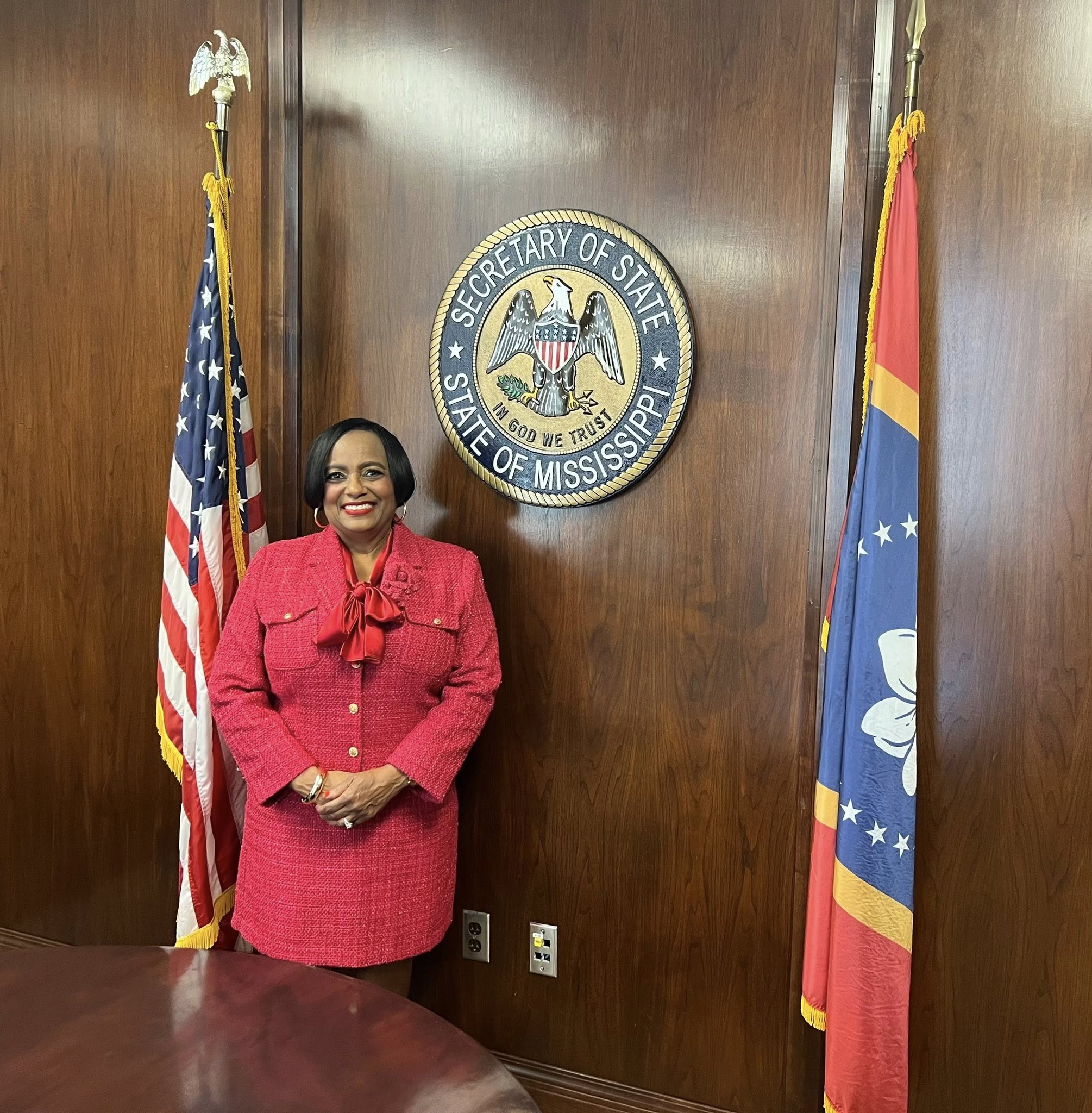
Hinds County Attorney, Bridgett Clayton, has qualified to run for Hinds County Chancery Judge!
“After much prayer and consideration, I am honored and excited to announce that I qualified for Hinds County Chancery Court Judge, District 5-3, on today.”
“I am ready to serve the citizens of Hinds County with God serving as a Lamp unto my feet and the Light unto my path as I seek election for this judicial seat to do justly, love mercy, and walk humbly before my God. Micah 6:8”
I am requesting your prayers and support during the campaign as well as on Election Day which is November 3.
Please be on the lookout for future campaign information. Thank You!
Matthew Thompson is a Chancery practitioner and knows-well the power, authority and responsibility that Chancellor’s have and the knowledge and wisdom they should possess. Attorney Bridgett Clayton has all of those qualities and then-some!
Please support Bridgett Clayton for Hinds County Chancellor!
Judges take an oath to uphold the Law. Most do, but some do not. The Code of Judicial Conduct are the standards for the ethical and professional conduct of judges.
So what do you do when the Judge rules against you?Sometimes it’s a judgment call and not a violation of the law. In these circumstances you can file a Motion for New Trial and/or an Appeal with the Mississippi Supreme Court.
But what about when the judge clearly violates the law? Can you sue the Judge? Usually, no. Judges have what is known as Judicial Immunity that protects them from civil liability for violating the law. If the actions are criminal there could be penalties, but typically not for civil violations.
However, if a Judge violates the Judicial Canons and violates your rights you do have options. What else can be done? You can Contact Mississippi Judicial Performance and file a COMPLAINT.
Judicial performance is an entity created by the Mississippi Constitution that seeks;
To enforce the standards of judicial conduct, To inquire into judicial liability and conduct, To protect the public from judicial misconduct and disabled judges, and To protect the judiciary from unfounded allegations.
All proceedings before the Commission are of a civil nature, not criminal, as the purpose of the Commission is to be rehabilitative and educational as well as disciplinary.
Any citizen, litigant, attorney, law enforcement official, judge, public official, or other individual who has knowledge of possible judicial misconduct may file a complaint with the Commission. Complaints may also be filed anonymously. Additionally, the Commission may file a complaint on its own motion based upon matters it learns of in other ways, such as from mass media and information obtained during the course of an investigation.
All complaints must be submitted to the Commission in writing. The Commission does not accept oral complaints. You may use a complaint form or write a letter to the Commission. A complaint form filed with the Commission should be typewritten or printed so that it is easily readable.
Complaints should include all information available regarding your case, the case number, Court it is in, the parties names, and any witnesses to the violation(s).
The complaint should include the specific conduct complained of and the violation alleged.
Matthew Thompson is an attorney in Mississippi and knows most Judges try to do it right…but for those that willfully do not do it right, Judicial Performance can address your concerns.
In what can only occur in our modern, social media-driven times, a North Carolina woman is found liable for breaking up a marriage and ordered to pay $1.75 million dollars to the wronged spouse. And her own TikTok videos were exhibits!!
Alienation of Affection allows the wronged spouse in a marriage to sue the “significant other” of the guilty spouse for the breakdown of the marriage. There are only 6 states in the country that still recognize AOA, but North Carolina and Mississippi are amongst them, and as recently as the 1990’s our Courts have refused to abolish this tort, reaffirming its place in the Mississippi legal system.
So what is AOA?
The elements are;
1) Wrongful Conduct (ie: adultery, though not required),
2) loss of affections, and
3) a causal connection.
All 3 must be present for a viable claim. There is a 3-year statute of limitations in which to bring the claim, beginning when the loss of affection is finally accomplished.
One of the issues that made this case especially egregious is that a tiktok video indicated that Brenay Kennard bought a pregnancy test after saying “I am getting down and dirty in the sheets.” At trial Kennard denied being sexually active at that time.
Another video featured Kennard saying, “I make her very uncomfortable.” Kennard admitted “her” referred to Akira Montague (the wife), but said “uncomfortable” could mean many things. She again denied being sexually active with Timothy Montague while he and Akira were together.
The jury did not buy it.
*As an aside, North Carolina has AOA and a separate tort called “criminal conversation” which only requires proof of sex with a married person for the “significant other” to be liable for damages. It does not require loss of affections or a causal connection or even a real relationship.
Thirteen years ago I typed these prophetic words, “So what is the take away here? Just because you are not married does not mean you have no culpability in an affair. You will be a necessary witness in the divorce case and stand a chance of getting sued yourself for AOA. And if you go to North Carolina, you better behave.“
$1.75 million dollars later and the above words are still true today!!
Matthew Thompson is a family law attorney in Mississippi and reminds you Alienation of Affection is alive and well and can make you pay!!
A child testifying is an often discussed issue between parents and attorneys in child custody cases.
When parents are getting a divorce the child usually knows more than their parents think. The child most likely witnessed fights, bad conduct and sometimes even dangerous conduct.
In Mississippi law, the leading authority is Jethrow vs. Jethrow, 571 So.2d 270 (Miss. 1990). This case lays the groundwork that the Court should use when assessing child testimony. The basic premise is, as follows;
A child witnesses of tender years*, 12 and under for testimony purposes, testifying is subject to the discretion of the Judge. (*this tender years is different than the “tender years” doctrine favoring a mother when a child is very young, under 2-3).
Before allowing such testimony the Judge “should satisfy himself that the child has the ability to perceive and remember events, to understand and answer questions intelligently, and to comprehend and accept the importance of truthfulness.”
Before excluding the testimony of a child witness of tender years in a divorce proceeding, the chancellor at a minimum should follow the procedure required by Crownover v. Crownover, 33 Ill.App.3rd 327, 337 N.E.2d 56 (1975):
The first hurdle is whether the child is competent to testify.
The Judge should confer in camera (meaning in the Judge’s chambers/office) with the child and determine whether or not the child’s testimony should be heard
The Judge has considerable discretion in conducting proceedings of this type, meaning it’s a judgment call.
The court should not, however, reject outright proposed testimony of a child in custody proceedings, where the omission of such crucial testimony might be harmful to the child’s best interests.
The trial court should take great pains to have an in camera conference with the child to determine the competency of the child,
and determine the competency of any evidence which the child might present.
The court should determine whether the best interests of the child would be served by permitting her to testify, or
Whether the child should be sheltered from testifying and being subjected to a vigorous cross-examination.
The Judge should report the essential material matters developed at the in camera conference on the record.
The Court should state the reasons for allowing or disallowing the testimony of the child, and
The Court should note the factual information which the court developed from the conference with the child which would be considered by the court in its ultimate determinations in the case.
Generally, the testimony of a child called as a witness in a divorce case should not be excluded for reasons other than competency, or evidentiary defects, or for the protection of the child. (24 Am.Jur.2d, Divorce and Separation, A 415). There should not be a summary refusal to inquire as to the competency of the child to testify and also of the competency of the proposed testimony of such child in a change of custody proceeding.
“We reiterate that parents in a divorce proceeding should if at all possible refrain from calling any of the children of their marriage, of tender years at least, as witnesses, and counsel should advise their clients against doing so except in the most exigent cases. The reason and wisdom behind this precaution need no amplification. We also hold, however, as we must that no parent can be precluded from having a child of the marriage in a divorce proceeding testify simply because of that fact.”Jethrow v. Jethrow, 571 So.2d 270, 274 (Miss. 1990)(emphasis added).
A child testifying should be avoided, however if it cannot be avoided the above process will likely be used by the Court to determine if and how the child will testify.
Matthew Thompson is a Child Custody Litigation Attorney in Mississippi.
I have written several times on sometimes just not being ready. I have seen multiple instances of person just not being ready…
What are the signs of Not Being Ready?
Things are moving TOO Fast.
The divorce process is actually fairly slow in Mississippi. It is typically at least 60 days with the average cases taking closer to 90 days, if uncontested. If contested, the case could take 6-18 months. A few take even longer!
Things are TOO Emotional.
Of course divorce is highly emotional. In some respects you may never “get over it.” However, the best results require that you treat the financial aspects as a business transaction. If you are so focused on the emotion, getting even or some other aspect, you’ll regret it later.
It makes NO Sense.
If you are in a brain fog and cannot explain in plain terms what the lawyer has explained to you, you may not be ready. I don’t expect you to know every legal term of art, but there are some very important concepts you need to understand.
These are just a few indicators of Not being ready. Be on the lookout for these signs in your spouse and/or yourself. Recognizing these issues will allow for them to be better handled.
Matthew Thompson is a Divorce and Custody lawyer in Mississippi and warns you that negotiating a divorce when you are not ready may result in regret.
Whether a child should testify is a decision that hopefully you as a parent will never face. The Mississippi Supreme Court, in a 1990 Opinion, held “We reiterate that parents in a divorce proceeding should …refrain from calling any of the children of their marriage, of tender years at least, as witnesses, and counsel should advise their clients against doing so except in the most exigent cases.”- Jethrow vs. Jethrow, 571 So.2d 270 (Miss. 1990).
For testimony purposes a child witness of “tender years” is 12 and under and testifying is subject to the discretion of the Judge.
However, a recent Court of Appeals case requires ALL children be interviewed by the Judge in every custody case if a parent calls the child as a witness. It is now mandatory regardless of the age of the child, regardless of who has custody, and regardless even when the other parent objects believing same will result in harm, emotional or otherwise, due to the very young age of the child and even over the objection of the Guardian Ad Litem appointed for the child. Daly v. Raines, No. 2022-CA-00600-COA
This is a scary proposition for most parents and something to consider when you are litigating. In divorce/custody/family law litigation your children will now be forced to participate if either parent so decides.
Be careful who you have a child with…
Matthew Thompson is a child custody and divorce lawyer in Mississippi and believes that only in exigent circumstance should child custody even be considered . However, the “law” doesn’t always allow for common sense to prevail…
A:No. I don’t know whose writing this is…I don’t know what those circles mean…
Attorney: Objection. It’s obviously not a true copy, as the original does not have writing and circles on it.
Court:Sustained.
Court rules can be tediously picky. If something isn’t phrased the right way, authenticated sufficiently, or previously produced, if requested, you may not be able to use it. This is true even if it is something important, reliable and tangible to the issues before the Court. This is just one reason why Court is so frustrating.
I had a case where the witness highlighted certain portions of an email. When the time came to testify about the email, the other party pretended to not recognize it, nor remember it. He wasn’t sure if he used that email address at that time. He certainly knew he didn’t highlight it and wasn’t sure he had seen it before. It was a dance of avoiding the obvious.
Ultimately, the email came in when the sponsoring party testified and I believe the other party lost credibility in feigning ignorance, however it was a good lesson on the rules/tricks of Court.
Matthew Thompson is a Family Law attorney in Mississippi and encourages you to practice, with your attorney, your testimony and how to authenticate an exhibit and get it into evidence.







 (601) 850-8000 - - BowTieLawyer.MS