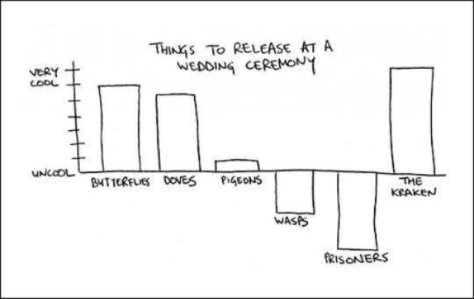
Scale of “Coolness” of potential things released at a Wedding Ceremony
Scale of “Coolness” of potential things released at a Wedding Ceremony
In Family Law, dealing with divorce and child custody issues are enough to keep any attorney busy. With ever-changing emotions, gray areas of the law relating to dividing assets and assessing how a particular judge may determine the best interests of a child, attorneys and clients don’t need more on their plate to deal with. But, there is more…Jail!

I have previously blogged on going to Jail for having sex and not paying child support, but there is another reason folks go to jail in their family law case, letting their emotions get the best of them.
It is quite common for Family law matters to “spill over” into Justice Court or Municipal Courts. Most commonly are assault, trespass and domestic violence violations. I have included portions of the statute for you to review, below and italicized common issues.
The severity of these charges depends in large part on the severity of the circumstances, the severity of injuries, if any, and whether there is a history of violations or abuse. Unfortunately, it is not uncommon for one spouse to attempt to use these criminal allegations to “one-up” the other and attempt to use the criminal charges as leverage in divorce negotiations.
Lawyers would be wise to warn their clients about the possibility of a client losing their cool, even once, leading to criminal charges and that, perhaps, their former significant other may “create” circumstances in the hopes of using those against them in a later or pending divorce action.
§ 97-3-7. Simple assault
(1) (a) A person is guilty of simple assault if he (i) attempts to cause or purposely…causes bodily injury to another; (ii) negligently causes bodily injury with a deadly weapon… or (iii) attempts by physical menace to put another in fear of imminent serious bodily harm; shall be punished by a fine of not more than Five Hundred Dollars ($ 500.00) or by imprisonment for not more than six (6) months, or both.
§ 97-17-85. Trespass; going upon inclosed land of another
If any person shall go upon the enclosed land of another without his consent, after having been notified by such person …not to do so …or shall remain on such land after a request by such person; shall, upon conviction, be fined not more than Fifty Dollars ($ 50.00).
§ 97-3-7. Simple domestic violence; Aggravated domestic violence
(3) A person is guilty of simple domestic violence who commits simple assault as described in subsection (1) of this section (see simple assault) against a current or former spouse … upon conviction, the defendant shall be punished as provided under subsection (1) …a third conviction of simple domestic violence…within five (5) years, the defendant shall be guilty of a felony and sentenced to a term of imprisonment not less than five (5) nor more than ten (10) years.
§ 97-3-7. Aggravated domestic violence
(4) A person is guilty of aggravated domestic violence who commits aggravated assault as described in subsection (2) of this section against, or who strangles, or attempts to strangle, a current or former spouse … Upon conviction, the defendant shall be punished by imprisonment in the custody of the Department of Corrections for not less than two (2) years nor more than twenty (20) years… a third conviction of aggravated domestic violence…within five (5) years, the defendant shall be guilty of a felony and sentenced to a term of imprisonment of not less than ten (10) nor more than twenty (20) years.
(2) (a) A person is guilty of aggravated assault if he (i) attempts to cause serious bodily injury to another, or causes such injury purposely, knowingly or recklessly under circumstances manifesting extreme indifference to the value of human life; (ii) attempts to cause or purposely or knowingly causes bodily injury to another with a deadly weapon or other means likely to produce death or serious bodily harm; or (iii) causes any injury to a child who is in the process of boarding or exiting a school bus in the course of a violation of Section 63-3-615; and, upon conviction, he shall be punished by imprisonment in the county jail for not more than one (1) year or in the Penitentiary for not more than twenty (20) years.
Matthew Thompson is a family law attorney that has only been to jail to help his clients get out. He intends to keep it that way and hopes (advises) that you do too!
Follow the blog: BowTieLawyer Visit the website: Thompson Law Firm
You may also contact Matthew with your family law case, question or concern at (601) 850-8000 or Matthew@wmtlawfirm.com.

There is an old joke that the only sure things in life are death & taxes. Even in divorce you still have to worry about death and taxes.
Death: I have had several pending cases ended by death. In one instance my client’s spouse died very suddenly of an accident. It ended a contested divorce and custody case that had been progressing very slowly and not particularly amicably. While the divorce and custody issues were over, it created new issues with the deceased spouse’s family. Grandparent visitation issues and intestacy issues arose, since the spouse died without a will (intestate). This made the surviving spouse and children equal beneficiaries. This was something the deceased’s side of the family was not to keen about.
I was also involved in a case where the non-custodial parent got custody of the children when the custodial parent died after the case was “over.” They had been divorced for a few years. But upon the custodial parent’s death the children when back to the surviving parent.
Death does not end the issues you have with the other parent or former spouse. I know a lot of divorcing spouses may think it will solve all of their problems if that so-and-so would just die, but it could leave your children without their other parent. It can create issues with the former in-laws, who now may be pursuing their rights of grandparent visitation. It can create financial uncertainty as support obligations end at death, usually, and there might not be insurance or enough insurance.
Be careful what you wish for…
Matthew Thompson is a family law attorney that hopes your case is not prolonged or shortened due to the death of your attorney. (Taxes will be the subject of another riveting post).
Follow the blog: BowTieLawyer
You may also contact Matthew with your family law case, question or concern at (601) 850-8000 or Matthew@bowtielawyer.ms

Valentine’s Day is one of the most popular days to get engaged! Along with Christmas and New Years, Valentine’s Day is the holiday for popping the question. But who gets the RING if things don’t pan out?
In Mississippi, the ring is a pre-marriage gift. It can be argued that the ring is actually a conditional gift creating a contractual obligation. How Romantic!
Here’s the scenario. An offer of marriage is proposed and a ring given in exchange for a “Yes,” being an agreement to marry. So long as both parties uphold their end; the fellow gives the ring and the lady marries the fellow = offer + acceptance & valuable consideration. At this point the contract is fulfilled and the rings is now the property of the lady. But what if they were only married for a minute? Well, if they married the contract is fulfilled. Certainly, there could be exceptions due to fraud or overreaching, but these are not typical.
The chancellor properly concluded that the engagement ring was a gift from [the fellow] to [the lady]. That gift necessarily predated the marriage of the parties. Thus, it was an asset brought by [the lady] into the marriage and was not a marital asset subject to equitable division. MacDonald v. MacDonald, 698 So.2d 1079 (¶ 13) (Miss.1997). It was, therefore, beyond the chancellor’s authority to order [the lady] to return possession of that item to [the fellow] and the refusal to do so cannot constitute reversible error on appeal. Neville v. Neville, 734 So.2d 352 (Ms.App. 1997).
Want to be safe, legally speaking anyway? Then make your marriage proposal contingent, as follows*:
“Dearest One,
I love you and desire to marry you. As a symbol of same, I am making a wholly contingent offer to you of this ring, of significant monetary and sentimental value, but a likewise sizable lien against same, in exchange for your promise to marry me. In the event that we do NOT get married, then said ring shall be returned to me in the same condition as presented, or alternatively you may elect to assume said lien, in full, for said ring and shall indemnify and defend me from any liability thereon. ‘Will you accept this rose?'” *(a paraphrase of colleague J. Kitchens)
Matthew Thompson is a family law attorney that you can engage in the event you need a divorce, and if you use the above contingent marriage proposal, you just might!

I previously blogged on 5 Family Law FaceBook Don’ts. This was a very popular blog topic and continues to generate a lot of traffic. This post lists 5 more things you should not be doing on FaceBook with regards to your family law case.
Posting inappropriate stuff on FB is not just an American thing. 1/5 of Australian divorces use FB postings to discredit some testimony that was offered by one party and FB activities are showing up in about 1/3 of United Kingdom divorce cases. Familyandthelaw.com.au
5 More Things not to Put on FaceBook:
Stay tuned for more FaceBook don’ts, as I have enough material to make this one a series and unfortunately am learning of new things not to do on an almost daily basis.
Matthew Thompson is a family law attorney in Mississippi that strives to not put inappropriate things on FB and thinks you should too! #Trust the Bow Tie.
Follow the blog: BowTieLawyer
Recently I was invited to be on the TV show LawCall. I decided to write about that experience; the good, the challenges, and the behind the scenes “secrets.
LawCall is a live, weekly, thirty-minute call-in show hosted by local personal injury attorneys Rocky Wilkins and Tim Porter of the law firms, Morgan & Morgan and Porter Malouf, respectively. The show features guests attorneys from across the state of Mississippi. Every show highlights usually an area law. The attorneys take live phone calls from viewers pertaining to that topic. My appearance was the Valentine’s edition; Love & the Law – Family Law in Mississippi.
This was not my first time on television discussing legal themes. I was previously a guest on the Local 98 TV Show The Reel Deal with Cole Berry discussing legal movies. I have also been on the radio discussing Father’s Rights on WLEZ, in preparation for the then upcoming Mississippi Volunteer Lawyers Project’s free family law seminar. I also routinely speak at CLEs (continuing legal education seminars) on Family Law. I really enjoy these opportunities to talk about what I do.
On LawCall the usual hosts were out-of-town so Ben Wilson, an attorney with Rocky Wilkins Firm, filled in for Rocky. Ben and I discussed general family law topics prior to the show. I also met and spoke with the moderator/ TV facilitator Tamica Smith. Tamica is a pro. She has been on the news and TV for over 15 years in various markets and was as cool as a cucumber.
When I arrived, I received my instructions from Charley Jones and his wife Angela. They produce LawCall. I received an ear piece where I could hear the control room and the callers. We did a run down, which is just a practice run of the show. I was told where I would be sitting, how the show would open, when to expect commercial breaks and generally where to look. This was the toughest part for me. There were 3 cameras. The one to my right I was never to look at. When the shot showed the whole panel I was to look into the middle camera and when I was speaking directly to the caller I was to look to the left camera. It took some practice and just as I was getting the hang of it the show was over!
There were 4-5 callers with some really good questions. There was a question about whether a new spouse would be responsible for the husband’s support obligation from a prior relationship. She would not be. There was a question about Grandparent’s rights. Grandparents have rights guaranteed by law in Mississippi. A caller asked about whether his alimony obligations could be changed. Based on what he described he could seek to modify his obligations.
Behind the scenes. One of the newscasters had on jeans. You only saw him from the waist up on TV so it did not matter… It made me think of the old joke showing all the newscasters in their “heart boxers” and suits up top. It was only water in the coffee mugs. I got to keep the mug. Also, I had one call to my office within one minute of the show ending and had another call at 9:05 a.m. Monday morning. How is that for marketing results!
Matthew Thompson is a family law attorney that has appeared on Local 98 TV, WLBT’s Law Call, WLEZ on the radio and at numerous speaking engagements. If you need a speaker or TV personality at your next Family Law Seminar/Banquet please contact Matthew about his low, low “Celebrity Appearance Fee!”
Follow the blog: BowTieLawyer Visit the website: Thompson Law Firm
You may also contact Matthew with your family law case, question or concern at (601) 850-8000

The Judge’s job in a custody/divorce case is to determine the best interests of the children when mom and dad are fighting. The Judge considers mom’s testimony and evidence as well as dad’s and even the children’s testimony (clickable). But there is also another implement in the tool box of information available to the Court, the Guardian Ad Litem (GAL).

A GAL is a person, usually a lawyer, appointed by the Court to take on one of two roles.
1) The first of these is to be an Attorney for the Children. To represent the child in the same capacity any attorney would represent a client, with the same duties, obligations and confidences that every attorney owes to each client. This role is fairly uncommon in custody/divorce actions.
2) The much more common role is that of Investigator for the Court. Judge’s routinely appoint an attorney to serve as the Court’s eyes and ears on the ground. Judge’s are limited to what they can hear.
They are limited by time constraints, objections, admissibility issues, and lawyer’s abilities. A GAL appointed by the Court as an Investigator has much more readily available access to information.
So why does every case NOT have a GAL?
1) They are only required in abuse/neglect cases, otherwise it is discretionary. The Court may not allow for a GAL.
2) It adds another layer of expense, another attorney to pay. The Court usually makes both parties pay.
3) It can create delay. The GAL may ask for more time to conduct the investigation and scheduling trial depends on another lawyer’s calendar.
4) The GAL may not believe you. They are human and may believe the other parent over you, plus you may be lying to them. It adds risk.
5) They may not do a good job.
GALs typically prepare a report that is provided to the Court and both lawyers. It recounts their efforts, interviews, documents reviewed and conclusions drawn. The GAL report also includes recommendations, usually. The Court is not required to follow the GAL recommendation.
Guardian Ad Litems can be a critically important tool available to the Court or parties in a contested custody battle, but the involvement of a GAL also has risks and expenses associated too. Talk to your lawyer if you have concerns about abuse/neglect and whether a GAL may help in your case.
Matthew Thompson is a family law attorney that has served as a GAL and has handled numerous cases involving GALs. He has seen the good, the bad and the ugly. He also conducts GAL training sessions at Continuing Legal Education Seminars for lawyers that want o become certified GALs; topics include conducting GAL Custody Evaluations, GAL Investigations, GAL Reports and Testifying.
Follow the blog: BowTieLawyer Visit the website: Thompson Law Firm
You may also contact Matthew with your family law case, question or concern at (601) 850-8000 or Matthew@bowtielawyer.ms.
Appeals are a necessary evil in Family Law. The following is a brief description of appealing Chancery Court matters, that is, family law cases.
An appeal is a request that a higher Court review the decision of the lower Court. A lot of family law decisions are appealed, though very few are successful or result in a significant change.
A decision is appealable if it is a Final Order. A Final Order is one which decides all of the then pending issues and leaves nothing more for the Court to decide. A Temporary Order (clickable), for example, is not appealable. It is not a Final Order, though it could be subject to modification in certain exigent circumstances.
A Final Order, rather, is your Final Judgment of Divorce or other similar document. It decides on a permanent basis the outcome of your case.
How do you appeal it? In Chancery Court there are several options available. The first is filing what is called a Motion for New Trial*. This is filed in the same Court and must be filed within 10 days of the entry of the Final Order. This goes back in front of the same judge and is not merely a chance for a “second bite at the apple,” but rather is to point out significant errors of fact and/or law upon which the Judge relied, which resulted in the wrong decision. These are routinely denied. They are denied for several reasons and primarily because the Judge just decided the case and also because it requires the Court to “admit” to making a mistake. Usually the case is fresh on the Judge’s mind and the Judge felt that he or she did not make a mistake. I have seen these most commonly granted when there is a mathematical error; the child support was calculated wrong or the asset division contained a significant computation error. If the “error” is not something obvious these have a very low probability of success. (*There has been some debate over whether a Motion for New Trial is required to perfect an appeal. The most recent answer is that it is not required in family law matters, however it is a good idea to file one out of an abundance of caution. Please rely upon your attorney for making this decision.)
After the Motion for New Trial is denied you may file a Notice of Appeal. This is filed, again, with the Chancery Court and must be filed within 30 days of either the Final Judgment, or within 30 days of the ruling on the Motion for New Trial, whichever is later.
All appeals are sent to the Mississippi Supreme Court (MSSC). From there the MSSC gets to decide if they keep the case or assign it to the Court of Appeals (COA). The majority of the Family Law cases are assigned to the COA.
The Appeal process is deadline heavy. There are deadlines to file the appeal, to pay an estimate of preparing the transcript, to designate the record. After which, a briefing schedule is issued. The one appealing, the Appellant, has 40 days to file their brief and can get multiple extensions of 30, 20, and 10 days. The Appellee, the one responding to the appeal, then has 30 days to reply and can get extensions of 30, 20, and 10 days. The Appellant can then file a reply brief within 14 days, with up to one extension of 30 days. After all the briefs are submitted the Court may allow Oral Argument, if it is a case of first impression or complex, and the Court may not. Once the briefs are submitted the Court has 270 days to rule. They rule in a written Opinion that is handed down on either Tuesdays or Thursdays after 1:00 pm.
Even if you “win” you may not. Usually appeals are denied. When they are granted it usually results in the matter being remanded to the lower Court with instructions for the Judge to redo a certain part or reconsider certain facts or law. It does not guaranty a change in the outcome and you may end up back in front of the same Judge that ruled against you.
Appeals are long, costly, and even if you “win,” you may not “win.” Consult with an attorney experienced in handling appeals if you think there were significant errors made in your case.
Matthew Thompson is a family law attorney that has been involved in about 20 appeals.
Follow the blog: BowTieLawyer



 (601) 850-8000 - - BowTieLawyer.MS